

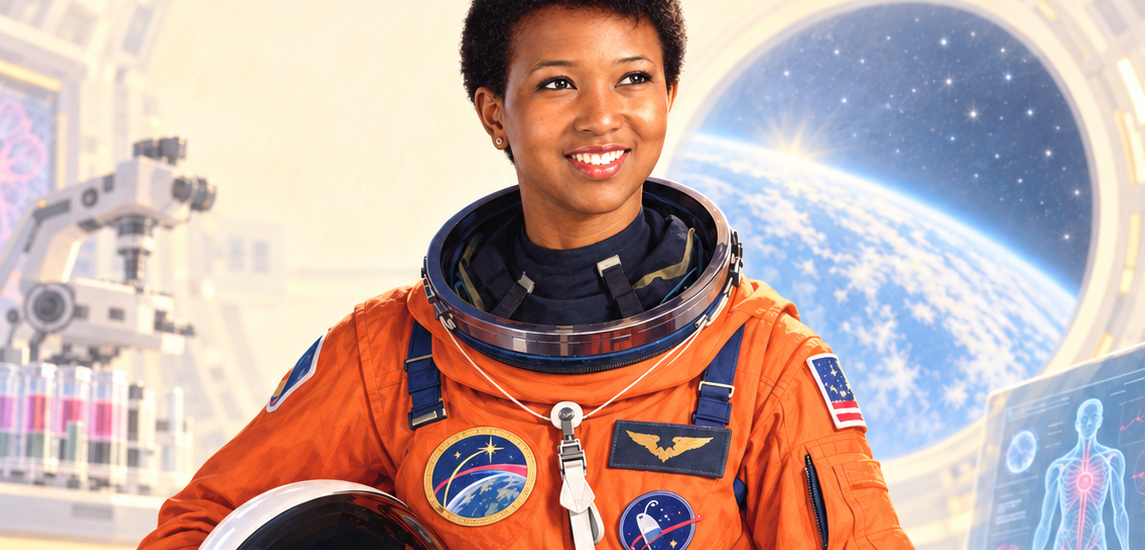
Mae Carol Jemison is an American physician, engineer, astronaut, educator and entrepreneur whose career has moved across medicine, global development, space exploration, technology and education. Born in Decatur, Alabama, and raised on Chicago’s South Side, she entered Stanford University at 16, earned degrees in chemical engineering and African and Afro-American Studies, then earned her medical degree from Cornell University. After practising medicine and serving as a Peace Corps medical officer in Sierra Leone and Liberia, she joined NASA’s astronaut corps in 1987. On September 12, 1992, Jemison launched aboard Space Shuttle Endeavour on mission STS-47 and became the first Black woman to travel into space.
Category: Pioneer
Field: Space Exploration · Medicine · Engineering · Science & Technology · Education
The physician-engineer who became the first Black woman in space—and spent the rest of her career expanding who gets to imagine the future.
At a Glance
Spaceflight is only one chapter of Jemison’s work. Since leaving NASA in 1993, she has founded technology companies, built science-literacy programmes for young people, taught sustainable technology, and led 100 Year Starship, a global initiative working toward the capabilities required for human travel to another star within a century. Her work consistently joins disciplines that are often treated as separate—engineering and social science, medicine and technology, science and art—to ask not only what humanity can build, but who gets to participate in building the future.
| Born | October 17, 1956 — Decatur, Alabama, United States |
| Country | United States |
| Field | Aerospace, medicine, engineering, science education and futures |
| Known For | First Black woman in space; STS-47; science literacy; 100 Year Starship |
| Education | Stanford University — B.S., Chemical Engineering; B.A., African and Afro-American Studies, 1977; Cornell University Medical College — M.D., 1981 |
| Major Roles / Organizations | NASA; Peace Corps; The Jemison Group; Dorothy Jemison Foundation for Excellence; 100 Year Starship; NASA Innovative Advanced Concepts External Council |
| First / Record / Milestone | First Black woman to travel into space; first real-life astronaut to appear on Star Trek |
| GDT Category | Pioneer |
Why She’s a Girls Do That Champion
Mae Jemison’s story matters because she refused the idea that a person has to become only one thing.
She was interested in chemistry and dance. Engineering and African American studies. Medicine and space. Technology and culture. She did not treat those interests as contradictions requiring her to choose which version of herself was legitimate.
That matters for girls.
Girls are frequently encouraged to reduce themselves early: Are you artistic or technical? A scientist or a humanist? A leader or a caregiver? Practical or imaginative?
Jemison’s life offers another answer.
You can build an intellect large enough to hold all of it.
At Stanford, she studied chemical engineering while pursuing African and Afro-American Studies and continuing her training in dance. At Cornell, she studied medicine while remaining connected to movement and the arts. As an astronaut, she brought both engineering and medical expertise into space. Later, she became one of the most forceful advocates for rejecting the artificial separation between arts and sciences altogether.
Her story also expands what pioneering means.
Being first is historically important. But being first matters even more when the person who crosses the barrier turns around and questions why the barrier existed in the first place.
Jemison has spent decades arguing that science, engineering and space exploration belong to everyone—and creating programmes that allow more young people to participate in them.
Girls Do That chose Mae Jemison because she did not simply enter the future. She insisted that the future belongs to all of us.
Her Story
The Girl Who Expected to Go to Space
Mae Jemison was born in Decatur, Alabama, in 1956 and moved with her family to Chicago when she was three.
She grew up during the Apollo era, fascinated by astronomy, anthropology, archaeology and science. But while the United States celebrated astronauts as national heroes, the astronauts children saw publicly were overwhelmingly white men.
Jemison noticed.
She would later explain that she did not see space exploration as belonging naturally to one group of people. As a child on Chicago’s South Side, she already imagined herself participating in it.
Science was not her only passion.
She also loved dance.
That combination—scientist and dancer—would become central to how Jemison understood creativity for the rest of her life.
Stanford at Sixteen
Jemison entered Stanford University at age 16.
She studied chemical engineering while also pursuing African and Afro-American Studies, graduating in 1977.
The combination is revealing.
Engineering gave Jemison tools for understanding physical systems. African and Afro-American Studies gave her another framework for understanding societies, history, power and culture.
She continued dancing as well.
Rather than viewing science and the humanities as competing intellectual worlds, she developed an approach that treated technological problems as inseparable from the human environments in which technologies operate.
That perspective would eventually shape everything from her work in global health to her thinking about interstellar travel.
Becoming a Doctor
After Stanford, Jemison attended Cornell University Medical College, earning her M.D. in 1981.
Her medical training took her well beyond a traditional classroom. During medical school, she participated in medical work in places including Kenya and a Cambodian refugee camp in Thailand. She later completed her medical internship at Los Angeles County–USC Medical Center and worked as a general practitioner.
Medicine gave Jemison another way of understanding systems.
A disease is biological.
But whether a patient gets treated can depend on infrastructure, geography, technology, education, economics and politics.
Those relationships became even clearer in West Africa.
Medicine in Sierra Leone and Liberia
From 1983 to 1985, Jemison served as an Area Peace Corps Medical Officer for Sierra Leone and Liberia.
She was responsible for healthcare systems serving Peace Corps personnel, including clinical care, medical staff, pharmacy and laboratory operations, health education and safety procedures. Her work also included participation in research related to diseases and vaccines.
The experience put advanced medical knowledge alongside environments where resources could be limited.
That contrast remained influential in her later work.
Jemison increasingly became interested not simply in whether technologies could be invented, but whether they could be designed to function meaningfully in the societies that needed them.
Applying to NASA
Jemison had wanted to travel into space since childhood.
After returning from the Peace Corps, she resumed medical practice in Los Angeles and continued studying engineering.
Then she applied to NASA.
She was selected as an astronaut candidate in 1987 and completed training as a mission specialist. Her NASA assignments included launch-support activities and work verifying Space Shuttle computer software before she received her flight assignment.
The astronaut corps she entered was beginning to change.
Sally Ride had become the first American woman in space in 1983. Guion Bluford had become the first African American in space that same year.
But no Black woman had yet gone.
Mae Jemison would.
STS-47
At 10:23 a.m. on September 12, 1992, Space Shuttle Endeavour lifted off from Kennedy Space Center.
Mae Jemison was aboard.
With that launch, she became the first Black woman in space.
Jemison was not aboard simply as a symbolic passenger.
She served as Science Mission Specialist on STS-47, also known as Spacelab-J, a joint United States–Japan mission devoted heavily to scientific research.
Over eight days, the crew completed 127 orbits of Earth and carried out 44 life-science and materials-processing experiments. Jemison worked on experiments concerning human adaptation to weightlessness and served as a co-investigator on research involving bone cells.
By the time Endeavour landed on September 20, she had logged 190 hours, 30 minutes and 23 seconds in space.
One barrier had disappeared.
Looking Down at Chicago
Years later, Jemison described looking down from orbit and recognizing Chicago.
The significance went beyond geography.
Somewhere inside that enormous city was the neighborhood where a little Black girl had once looked upward and imagined herself in space without seeing anyone who looked like her doing it.
Now she was looking back.
Representation does not create ability.
The ability was already there.
What representation can change is whether a child understands that the pathway belongs to her too.
From Star Trek to the Real Space Programme
Jemison had grown up watching Star Trek, particularly appreciating a fictional future in which people of different races and nationalities participated in space exploration.
The connection eventually travelled in the opposite direction.
After leaving NASA, Jemison appeared in a 1993 episode of Star Trek: The Next Generation as Lieutenant Palmer.
She became the first real-life astronaut to appear in the franchise.
It is a delightful loop in her story:
science fiction helped a young girl imagine herself in space.
She became an astronaut.
Then the astronaut stepped into the science fiction that had helped her imagine the future.
Leaving NASA
Jemison left NASA in March 1993.
For many people, becoming an astronaut would have been the destination.
For Jemison, it became another platform.
She founded The Jemison Group, a technology consulting company focused on integrating social and cultural considerations into science and engineering projects. Its work has explored technologies including healthcare delivery, sustainability and development.
That move captures an important part of her intellectual philosophy.
Technology is never simply hardware.
A technically brilliant solution that ignores the people, institutions and cultures expected to use it may still fail.
Jemison wanted those questions considered at the beginning of technological design rather than added after the engineering was complete.
The Earth We Share
In 1994, Jemison created The Earth We Share, an international science programme for students aged 12 to 16 through the Dorothy Jemison Foundation for Excellence.
The programme does not simply ask students to memorise scientific facts.
It places them inside complex problems and asks them to think analytically, work together and develop solutions.
Over time, The Earth We Share and related programmes have reached thousands of students and trained hundreds of educators.
The underlying idea is powerful:
science literacy is not merely knowing science. It is learning how to think.
Art Is Not the Opposite of Science
One of Jemison’s most distinctive arguments is that society creates a false division between the arts and sciences.
She knows that division personally.
She is an engineer.
A physician.
An astronaut.
And a dancer.
In her widely viewed TED talk, “Teach Arts and Sciences Together,” Jemison argues that analysis and imagination are not opposites. Both science and art emerge from human creativity and our desire to understand and shape the world.
This makes her especially important for Girls Do That.
Her career does not merely tell a girl:
You can become a scientist.
It tells her:
You do not have to amputate the creative parts of yourself in order to become one.
A Hundred-Year Problem
Then Jemison made the timeline much longer.
In 2012, a team led by the Dorothy Jemison Foundation for Excellence won a $500,000 DARPA seed grant to develop the 100 Year Starship initiative.
Its ambition is extraordinary:
Ensure that humanity possesses the capabilities required for human travel beyond our solar system to another star within roughly a century.
The organisation does not claim that a starship will launch tomorrow.
Instead, it uses interstellar travel as a forcing function.
What breakthroughs would humans require in propulsion?
Energy?
Medicine?
Human psychology?
Food?
Governance?
Sustainability?
Communication?
Artificial intelligence?
Social organisation?
The point is that solving problems difficult enough for interstellar travel may produce technologies and systems valuable on Earth long before anyone leaves the solar system.
Jemison describes the philosophy simply:
pursue an extraordinary tomorrow to create a better world today.
Building Futures, Not Just Predicting Them
Today, Jemison continues to lead 100 Year Starship while working across science, medicine, engineering, education and technology.
Her current work includes roles with the NASA Innovative Advanced Concepts External Council, the Hagler Institute for Advanced Study, and Texas A&M’s engineering-medicine programme, alongside her continuing work through the Dorothy Jemison Foundation and other organisations.
Her career now spans more than five decades.
Yet the underlying question has remained remarkably consistent:
Who gets to participate in the future?
Not just who gets to consume new technology.
Who gets to imagine it.
Design it.
Question it.
Build it.
And decide what it is for.
Mae Jemison became the first Black woman to travel into space.
Her larger legacy is the insistence that “first” should eventually become ordinary.
Milestones
| Year | Milestone |
|---|---|
| 1956 | Born October 17 in Decatur, Alabama. |
| 1959 | Moves with her family to Chicago, where she grows up on the South Side. |
| 1973 | Enters Stanford University at age 16. |
| 1977 | Graduates from Stanford with degrees in chemical engineering and African and Afro-American Studies. |
| 1981 | Earns her M.D. from Cornell University Medical College. |
| 1983–1985 | Serves as Area Peace Corps Medical Officer for Sierra Leone and Liberia. |
| 1987 | Selected for NASA astronaut training. |
| 1988 | Completes astronaut training as a mission specialist. |
| 1992 | Launches aboard Endeavour on STS-47 and becomes the first Black woman in space. |
| 1992 | Completes 127 Earth orbits and logs more than 190 hours in space. |
| 1993 | Leaves NASA and establishes The Jemison Group. |
| 1993 | Appears on Star Trek: The Next Generation, becoming the first real astronaut to appear in the franchise. |
| 1994 | Launches The Earth We Share international science programme. |
| 1999 | Appointed an Andrew D. White Professor-at-Large at Cornell University. |
| 2001 | Publishes her autobiography, Find Where the Wind Goes: Moments From My Life. |
| 2002 | Delivers her influential TED talk arguing for the integration of arts and sciences. |
| 2012 | Leads the team awarded DARPA seed funding to develop 100 Year Starship. |
| 2017 | Launches LOOK UP, encouraging people worldwide to reconnect through the shared sky. |
| 2018 | Named a Stanford Engineering Hero. |
| 2022 | Receives the West Point Sylvanus Thayer Award. |
| 2023 | 100 Year Starship marks its tenth anniversary with Nexus Nairobi in Kenya. |
| Today | Continues leading 100 Year Starship and working across science, technology, medicine and education. |
In Her Own Words
“You don’t have to wait for permission.”
— Mae Jemison, in an interview with Scholastic about pursuing the work you intend to do.
“Pursuing an extraordinary tomorrow creates a better world today.”
— Mae Jemison, describing the philosophy behind 100 Year Starship.
“A sense of humor, a sensibility to improve and a willingness to act are requirements for thriving.”
— Mae Jemison, Notes to Self.
Read · Watch · Listen
Read
Find Where the Wind Goes: Moments From My Life — Mae Jemison
Jemison’s own account of her childhood, education, medicine, the Peace Corps and the journey that eventually took her into space.
Explore Find Where the Wind Goes
Former Astronaut Mae C. Jemison — NASA
NASA’s official biography covering her medical background, astronaut selection and STS-47 mission.
Changing the Face of Medicine — National Library of Medicine
A particularly useful account of Jemison’s development as a physician, engineer and astronaut.
Read the National Library of Medicine profile
Mae Jemison — Stanford Engineering
A concise profile of her education, spaceflight and later work.
Watch
Teach Arts and Sciences Together — TED
Jemison challenges the idea that creativity belongs to art while logic belongs to science and argues instead for educating whole thinkers.
I Wanted to Go Into Space — PBS
A short first-person reflection on growing up in Chicago wanting to become an astronaut and eventually looking back at the city from orbit.
The Secret Life of Scientists and Engineers: Mae Jemison — NOVA
A collection of short films covering space, dance, Star Trek and the 100 Year Starship.
Dr. Mae Speaks at the White House on the U.S. Return to UNESCO
Jemison speaking at the White House during the United States’ return to UNESCO.
Watch via Dr. Mae Jemison’s official site
Listen
A Conversation with Dr. Mae Jemison — StarTalk Radio
Neil deGrasse Tyson and Jemison discuss Chicago, medicine, dance, NASA, interstellar travel and why the human side of technological problems matters.
Mae Jemison of the 100 Year Starship Initiative — Planetary Radio
A conversation devoted to the science and ambition behind the 100 Year Starship.
Listen via The Planetary Society
Mae Jemison on Houston, Infrastructure and Resilience — NPR
A conversation that shows Jemison applying her systems perspective to infrastructure and public resilience on Earth.
Go Deeper
Official Mae Jemison Website
drmae.com
NASA — Mae Jemison
NASA biography
100 Year Starship
100yss.org
National Library of Medicine — Changing the Face of Medicine
Mae Jemison biography
Stanford Engineering — Mae Jemison
Stanford profile
The Planetary Society — Mae Jemison
Mae Jemison profile
Sources & Further Reading
100 Year Starship. (n.d.). Humanity’s interstellar future. https://100yss.org/
Cornell University. (2002, March 12). Former astronaut Mae Jemison visits Cornell March 25–30 to give a lecture and meet with faculty, students and local officials. Cornell Chronicle
Jemison, M. (2001). Find where the wind goes: Moments from my life. Scholastic.
Jemison, M. C. (n.d.). Mae Jemison, M.D. profile. Dr. Mae Jemison official website
National Aeronautics and Space Administration. (n.d.). Former astronaut Mae C. Jemison. NASA
National Aeronautics and Space Administration. (2019, March 1). Mae Jemison, first African American woman in space. NASA
National Library of Medicine. (n.d.). Biography: Dr. Mae C. Jemison. Changing the Face of Medicine. National Library of Medicine
PBS. (2014, July 31). Mae Jemison: I wanted to go into space. Secret Life of Scientists and Engineers. PBS
Scholastic. (n.d.). Interview with Dr. Mae Jemison. NASA: Challenging the Space Frontier. Scholastic
Stanford University School of Engineering. (n.d.). Mae Jemison. Stanford Engineering
StarTalk Radio. (2019, January 25). A conversation with Dr. Mae Jemison. StarTalk
TED. (2009, May 5). Mae Jemison: Teach arts and sciences together [Video]. TED
The Planetary Society. (2012, July 9). Mae Jemison of the 100 Year Starship Initiative. Planetary Radio. The Planetary Society
Carry the possibility with you.
Explore the Girls Do That Pioneer Collection—books, apparel, stationery and other products celebrating women and girls who cross boundaries, open new paths and expand what the rest of us can imagine.
Every collection helps fund a Girls Do That Club for the next generation.