
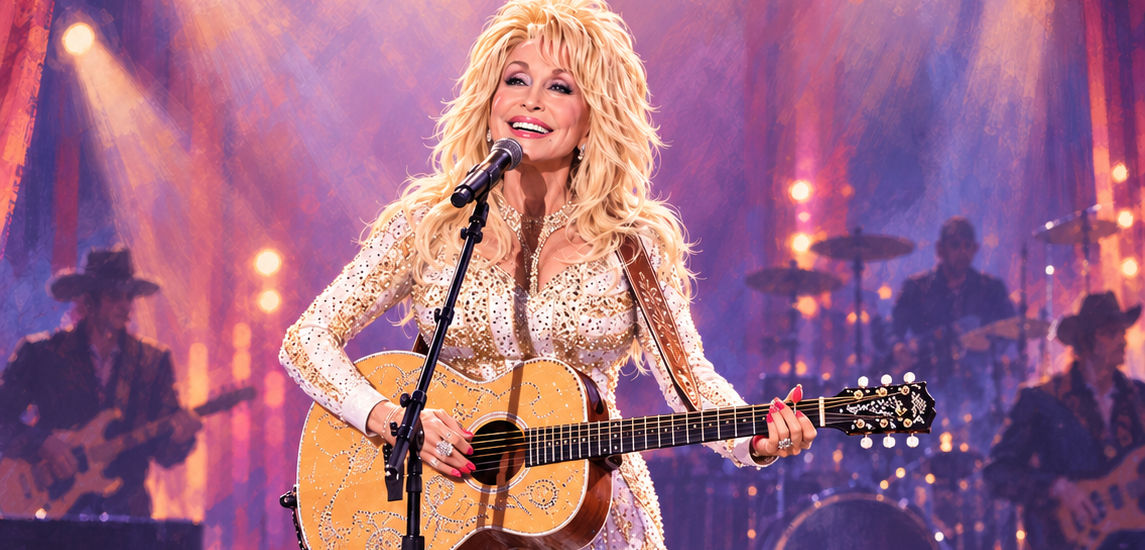
Dolly Rebecca Parton was an American songwriter, recording artist, actor, producer, entrepreneur and philanthropist whose seven-decade career developed into a portfolio spanning music publishing, recorded music, film and television, tourism, hospitality, consumer licensing and early-childhood literacy. Born in Sevier County, Tennessee, in 1946, she moved to Nashville immediately after finishing high school in 1964 and built her initial career as a songwriter before becoming one of the most commercially successful recording artists in country music. By the time of her death in Nashville on August 25, 2026, she had sold more than 100 million records worldwide, written approximately 3,000 songs, accumulated 25 Billboard country No. 1 hits, and built a business portfolio extending far beyond recorded music.
Category: Builder
Field: Music · Songwriting · Intellectual Property · Entertainment · Tourism · Hospitality · Early Literacy
The songwriter and entrepreneur who converted creative ownership into a multi-sector business platform, then applied the same institution-building logic to tourism, education, disaster response and one of the world’s largest early-childhood book-distribution systems.
EXPLORE THE BUILD COLLECTION →
At a Glance
Parton’s career can be understood as a sequence of asset creation. Songwriting generated copyrights. Publishing retained participation in the economics of those copyrights. Recorded music and performance built audience. Film and television expanded that audience beyond country music. Dollywood converted cultural recognition and regional identity into a physical tourism business. Licensing extended the brand into consumer categories without requiring Parton to manufacture each product herself. The Dollywood Foundation then used accumulated capital and institutional capacity to support education, disaster response and health initiatives, including Dolly Parton’s Imagination Library, which by 2026 had distributed more than 300 million books across five countries.
| Born | January 19, 1946 · Sevier County, Tennessee, United States |
| Died | August 25, 2026 · Nashville, Tennessee, United States |
| Country | United States |
| Field | Music, songwriting, intellectual property, entertainment, tourism, hospitality, consumer licensing and early literacy |
| Known For | “Jolene,” “I Will Always Love You,” “9 to 5,” Dollywood, songwriting ownership and Dolly Parton’s Imagination Library |
| Education | Sevier County High School, Class of 1964 |
| Major Roles / Organizations | Owepar Publishing; Velvet Apple Publishing; RCA; Dolly Records; Sandollar Productions; Dollywood; The Dollywood Foundation; Dolly Parton’s Imagination Library |
| Major Milestones | 25 Billboard country No. 1 hits; Country Music Hall of Fame; Songwriters Hall of Fame; Rock & Roll Hall of Fame; more than 100 million records sold |
| GDT Category | Builder |
Why She’s a Girls Do That Champion
Dolly Parton’s commercial history distinguishes several forms of economic participation that are often collapsed into the word success.
A performer can be paid to sing a song.
A recording artist can receive royalties from a master recording.
A songwriter can own or participate in the copyright to the underlying composition.
A publisher can administer those rights.
A producer can own or participate in film and television assets.
A brand owner can license intellectual property to manufacturers.
An equity partner can own part of an operating company.
Parton participated across several of these layers.
Her early decision to build publishing infrastructure meant that songwriting could produce an owned asset rather than only income from performance. Her investment in Dollywood converted celebrity and regional identity into a place-based operating business. Her consumer portfolio later relied heavily on licensing and strategic partnerships, allowing the Dolly Parton brand to enter food, beauty, wine, homeware and other categories without vertically integrating every manufacturing operation. The Imagination Library used another model: centralized infrastructure combined with decentralized local financing and enrolment.
The recurring pattern was the conversion of creative output into durable systems of ownership, distribution and access.
Her Story
The Product Existed Before the Celebrity
Dolly Rebecca Parton was born on January 19, 1946, in the Great Smoky Mountains of East Tennessee, the fourth of twelve children of Robert Lee Parton and Avie Lee Owens Parton.
Music was embedded in family and community life. She began composing in early childhood. Her official biography identifies “Little Tiny Tasseltop,” a song about a homemade corncob doll, as one of her earliest compositions. By ten, she was performing on local radio and television. At thirteen, she appeared at the Grand Ole Opry.
After graduating from Sevier County High School in 1964, Parton left for Nashville.
Her earliest durable professional asset was not celebrity.
It was songwriting.
In 1965, she signed with Monument Records and obtained a songwriting agreement with Combine Music. Her debut studio album, Hello, I’m Dolly, followed in 1967.
Publishing Before Global Fame
In 1967, Parton and her uncle Bill Owens established Owepar Publishing.
The company was created early enough in Parton’s career that much of the catalogue later associated with her global success had not yet been written.
Owepar published Parton’s work and material by other writers and eventually acquired property on Nashville’s Music Row. Porter Wagoner later became a partner.
After Parton and Wagoner separated professionally and settled their business interests, Owepar ceased operating in its original form. Parton later established Velvet Apple Publishing, which became another vehicle for administering her compositions.
The decision to own publishing would become central to the economics of her career.
A musical composition and a sound recording are separate intellectual-property assets.
The songwriter owns or participates in rights to the composition: the words and melody.
The owner of a master recording controls a particular recorded performance.
Parton’s catalogue allowed her to benefit when other artists recorded songs she had written even if she did not own their recordings.
No example demonstrates this more clearly than “I Will Always Love You.”
“I Will Always Love You”
Parton wrote “I Will Always Love You” while preparing to leave Porter Wagoner’s television programme and professional partnership.
Her own recording reached No. 1 on Billboard’s country chart in 1974.
She recorded it again for the 1982 film The Best Little Whorehouse in Texas. The new version also reached No. 1 on the country chart.
Then came a radically different recording.
Whitney Houston recorded “I Will Always Love You” for The Bodyguard in 1992. Houston’s version spent 14 weeks at No. 1 on the Billboard Hot 100 and became one of the defining pop recordings of the decade.
Parton did not own Houston’s master.
She owned the composition.
That ownership had been tested years earlier.
Elvis Presley wanted to record the song, but his manager, Colonel Tom Parker, required Parton to surrender half of her publishing rights as a condition of the recording.
Parton declined.
The Presley recording never happened.
The publishing remained hers.
The U.S. Copyright Office has used the relationship between Parton’s composition and Houston’s recording as an example of the distinction between copyright in a musical work and copyright in a sound recording.
The decision established a principle that ran through much of Parton’s business career:
distribution could be negotiated; ownership was harder to replace once surrendered.
Porter Wagoner and National Distribution
Parton joined The Porter Wagoner Show in 1967.
The programme gave her national television exposure and a major platform in country music. She and Wagoner became one of the genre’s leading duet partnerships, recording a long series of albums together while Parton continued developing her solo career.
In 1969, she became a member of the Grand Ole Opry.
In 1971, “Joshua” became her first solo No. 1 country single.
The same period produced Coat of Many Colors, followed by a particularly consequential run of songwriting that included “My Tennessee Mountain Home,” “Jolene” and “I Will Always Love You.”
By the time she left Wagoner’s programme in 1974, Parton had both national visibility and an increasingly valuable catalogue of compositions.
“Jolene”
“Jolene” was released in 1973 and became a country No. 1 in 1974.
Its commercial life extended far beyond its initial chart run.
The song has been recorded and performed by artists across country, rock, pop, bluegrass and other genres. Later versions and reinterpretations continually returned the underlying composition to public circulation.
The commercial value of a durable song catalogue lies partly in this capacity for reactivation.
A recording can age.
A composition can continue generating new recordings.
“Jolene” became one of the clearest examples of that distinction in Parton’s catalogue.
Crossover Without Abandoning the Core
Parton’s 1977 album Here You Come Again represented a deliberate expansion toward pop production.
The title track reached No. 1 on the country chart and No. 3 on the Billboard Hot 100.
The move did not require her to discard the catalogue or audience she had already built.
It expanded the number of markets in which Dolly Parton could operate.
Country radio remained a platform.
Pop radio became another.
Television increased reach.
Film would soon add another distribution channel.
The audience created by one business unit increased the potential value of the next.
9 to 5
Parton made her major film debut opposite Jane Fonda and Lily Tomlin in the 1980 workplace comedy 9 to 5.
She also wrote and performed the title song.
“9 to 5” reached No. 1 on the Billboard Hot 100 and the country chart and won Grammy Awards for Best Country Song and Best Country Vocal Performance, Female. It received an Academy Award nomination for Best Original Song.
The intellectual property later moved into another medium.
Parton wrote the music and lyrics for 9 to 5: The Musical. The Broadway production opened in 2009, and her score received a Tony nomination.
The same core property therefore generated value through film, soundtrack, recorded music, publishing, stage performance and cast recordings.
Film and Television
Parton’s screen career expanded through projects including:
The Best Little Whorehouse in Texas
Rhinestone
Steel Magnolias
Straight Talk
Joyful Noise
She also developed production capacity through Sandollar Productions, which participated in film and television work.
Her 1987–88 television variety series Dolly was backed by an unusually large network commitment but did not become a durable hit.
The failure is relevant to the structure of the wider portfolio.
Parton’s economic platform did not depend on every individual recording, television series or brand extension succeeding.
The value lay in diversification across intellectual property, performance, production, physical assets and later licensing.
Dolly Records and Greater Recording Control
Parton established Dolly Records in 2007.
Her 2008 album Backwoods Barbie was released through the label.
By then, her career had passed through several different forms of control:
recording for major labels,
publishing her compositions,
producing screen projects,
and operating her own record label.
Her later catalogue also moved across genres with unusual flexibility.
She recorded bluegrass.
Children’s music.
Gospel.
Christmas albums.
Collaborative projects.
Family material.
And in 2023, at 77, she released the rock album Rockstar.
Her catalogue continued to generate new commercial activity more than five decades after her first studio album.
The Business Architecture
Parton’s commercial interests did not all use the same ownership structure.
| Asset / Business | Structure | Economic Function |
|---|---|---|
| Songwriting catalogue | Copyright and publishing ownership | Royalties, synchronization, licensing and long-duration catalogue value |
| Owepar Publishing | Publishing company | Early administration and ownership of compositions |
| Velvet Apple Publishing | Publishing company | Continued administration of Parton and family publishing assets |
| Dolly Records | Record label | Greater control over later recording projects |
| Sandollar Productions | Film and television production | Participation beyond acting and music licensing |
| Dollywood | Equity partnership with Herschend | Tourism, entertainment, employment and hospitality |
| Dollywood resorts and water park | Physical destination expansion | Increases visitor stay, spending and year-round destination economics |
| Consumer products | Licensing and strategic partnerships | Extends brand into multiple product categories without full manufacturing ownership |
| The Dollywood Foundation | Nonprofit institution | Education, scholarships, disaster response and social programmes |
| Imagination Library | Central nonprofit infrastructure plus local partners | Large-scale recurring early-literacy distribution |
Dollywood
From Silver Dollar City to Dollywood
In 1986, Parton entered into partnership with the Herschend family around an existing East Tennessee theme park then operating as Silver Dollar City Tennessee.
The property reopened as Dollywood.
The effect on demand was immediate.
According to subsequent reporting, the park attracted approximately 1.3 million visitors in its first Dollywood season, substantially above the previous year.
Over the following four decades, the operation expanded beyond a theme park.
The broader destination came to include:
Dollywood
Dollywood’s Splash Country
DreamMore Resort and Spa
HeartSong Lodge & Resort
and additional entertainment and hospitality operations.
By 2026, the wider East Tennessee tourism platform associated with Parton was drawing around four million visitors annually. Reuters reported that she held an approximately 50% stake in the Dollywood business.
Why Dollywood Matters
Dollywood was not simply a name-licensing arrangement.
Parton held equity in an operating business.
That distinction changes the economics.
A licensing deal typically produces a fee or royalty.
Equity creates participation in the underlying asset.
The park also tied Parton’s commercial growth to the economy of the region where she was raised.
Tourism expenditure generated demand for:
employment,
hotels,
restaurants,
transport,
retail,
entertainment,
construction,
and surrounding visitor services.
Parton’s brand supplied demand.
The Herschend partnership supplied decades of operating experience.
The business converted both into regional tourism infrastructure.
From Theme Park to Destination
The expansion into hospitality increased the economic value of each visitor.
A day visitor may purchase an admission ticket, food and merchandise.
A multi-day visitor can also purchase accommodation, meals, resort activities and additional park experiences.
DreamMore Resort and HeartSong Lodge therefore extended Dollywood from an attraction into a destination platform.
The structure is materially different from music publishing.
Publishing scales through rights.
Tourism scales through physical capacity.
Parton built exposure to both.
Consumer Licensing
Parton’s later business expansion increasingly used licensing and strategic partnerships.
The approach allowed established manufacturers and distributors to provide technical capabilities while the Dolly Parton brand supplied audience, identity and intellectual property.
Food
In 2022, Duncan Hines, part of Conagra Brands, introduced Dolly Parton-branded Southern-style cake mixes and frostings.
The relationship expanded into additional baking products and later frozen foods.
By 2025, Conagra had launched a national line of Dolly Parton-branded frozen meals, including Southern-style products such as chicken and dumplings, country-fried steak and beef pot roast.
Beauty
Parton expanded her fragrance business into Dolly Beauty.
The beauty platform included lipstick and plans for additional lip, eye and face products.
Home
Her licensing portfolio extended into cookware, tabletop products, kitchen textiles and other home categories.
A partnership with Lodge Cast Iron connected the brand to a long-established American cookware manufacturer.
Wine
Dolly Wines extended the portfolio into Chardonnay, Pinot Noir, Rosé and Prosecco across international markets.
Brand Economics
The importance of the licensing model is structural.
Parton did not need to own:
a cosmetics laboratory,
a frozen-food factory,
a cast-iron foundry,
or a winery
to participate economically in those categories.
The brand itself had become an asset capable of being licensed.
By the end of her career, the portfolio contained several distinct forms of capital:
copyright ownership
equity ownership
production entities
brand licensing
physical tourism assets
nonprofit institutions
The Dollywood Foundation
Parton founded The Dollywood Foundation in 1988.
Its early work focused on education in Sevier County.
The Foundation later expanded into early-childhood literacy, scholarships, disaster response and health-related giving.
The Buddy Program
In 1990, the Foundation launched the Buddy Program.
Seventh- and eighth-grade students were paired with a classmate.
Parton offered each student $500 if both students successfully completed high school.
The Foundation reports that the dropout rate for participating classes fell from approximately 35% to 6%.
The intervention was relatively simple.
It changed incentives.
It created peer accountability.
And it attached a measurable outcome to the programme:
finish school.
Scholarships
The Dolly Parton Scholarship was established in 2000.
The programme later developed into awards for graduating students from Sevier County high schools.
This placed the Foundation at another point in the education pipeline: transition from secondary education into further study.
But the Foundation’s largest education intervention began much earlier in a child’s life.
Dolly Parton’s Imagination Library
The Problem
Parton’s father, Robert Lee Parton, could not read or write.
His experience became the central personal motivation behind Dolly Parton’s Imagination Library, established in 1995.
Rather than attempting to intervene after children were already struggling in school, the programme targeted the period before formal education.
Children could enrol from birth.
One age-appropriate book would arrive at the child’s home every month.
Participation did not depend on family income.
A child enrolled from birth through age five could receive approximately 60 books before beginning kindergarten.
The First Scale
The first book order in 1995 contained just over 1,700 books.
The programme initially served children in Sevier County.
Then the operating model was redesigned so other communities could replicate it.
That decision transformed the initiative.
How the System Works
The Imagination Library operates through a combination of central infrastructure and local partners.
The central organization manages:
the Book Order System,
book selection,
wholesale purchasing,
administration,
and coordination of monthly mailings.
Local Program Partners operate within defined geographic areas.
They enrol children.
Conduct outreach.
Raise or secure local programme funding.
Maintain community relationships.
Families pay nothing for the books.
The structure solves several scaling problems simultaneously.
Central procurement creates purchasing leverage.
Central technology standardizes administration.
Central book selection maintains programme consistency.
Local fundraising distributes financing responsibility.
Local organizations provide community knowledge and enrolment capacity.
The result is a programme that can grow geographically without requiring the central Foundation to build and staff a branch office in every community.
Five Countries
The Imagination Library expanded beyond the United States into:
Canada
the United Kingdom
Australia
the Republic of Ireland
By 2026 it was operating across all five countries.
Growth of the Imagination Library
| Year | Scale Milestone |
|---|---|
| 1995 | Programme founded in Sevier County, Tennessee |
| 1995 | First book order exceeds 1,700 books |
| 2000 | Programme begins wider replication |
| 2003 | Reaches 1 million cumulative books |
| 2006 | Expands into Canada |
| 2007 | Expands into the United Kingdom |
| 2013–14 | Expands into Australia |
| 2016 | Reaches approximately 1 million books mailed per month |
| 2018 | Reaches 100 million cumulative books |
| 2019 | Expands into the Republic of Ireland |
| 2020 | Reaches 150 million cumulative books |
| 2022 | Reaches approximately 2 million books mailed per month |
| 2023 | Reaches 200 million cumulative books |
| 2024 | Cumulative distribution exceeds 264 million books |
| 2025 | Reaches 304,539,509 cumulative books by year end |
| 2025 | Distributes 40,356,668 books in one year |
| 2026 | More than 3 million books per month being sent to children worldwide |
The Imagination Library recorded 304,539,509 cumulative books gifted by the end of 2025, including more than 40.3 million distributed during that year alone. By 2026, the programme was sending more than three million books per month.
At that scale, the Imagination Library is no longer adequately described as a celebrity book giveaway.
It is early-childhood literacy distribution infrastructure.
Disaster Response
The My People Fund
In November 2016, wildfires devastated communities around Gatlinburg and Sevier County.
The Dollywood Foundation created the My People Fund.
Rather than limiting assistance to indirect grants, the programme provided recurring direct payments to families whose primary residences had been destroyed.
More than $12 million was ultimately distributed.
The intervention used a different operating model from the Imagination Library.
The literacy programme is recurring infrastructure.
The My People Fund was rapid-response financial relief.
Both relied on the institutional platform of the Foundation.
Hurricane Helene
Following Hurricane Helene in 2024, Parton and associated organizations committed more than $2 million toward relief and recovery efforts in Tennessee and North Carolina.
Again, the Foundation functioned as infrastructure through which capital could be mobilized rapidly when local need increased.
Health and Medical Research
Parton’s philanthropy also extended into health infrastructure and research.
In 2007, she helped raise approximately $1 million for a women’s services and birthing centre in Sevier County.
COVID-19 Research
In March 2020, Parton donated $1 million to Vanderbilt University Medical Center for coronavirus research.
The donation established the Dolly Parton COVID-19 Research Fund.
Research supported by that funding contributed to early work used in the evaluation of Moderna’s mRNA-1273 COVID-19 vaccine.
The relationship is sometimes simplified as “Dolly Parton funded the Moderna vaccine.”
The more precise account is that her donation supported Vanderbilt research that became part of the scientific ecosystem used in evaluating the vaccine.
The donation was consequential.
It was not the sole financing source for Moderna’s vaccine programme.
Pediatric Infectious Disease
In 2022, Parton donated another $1 million to Vanderbilt for pediatric infectious-disease research.
Her health philanthropy therefore moved beyond one emergency grant into continued research support.
A Business Built Around Intellectual Property
By the later stages of Parton’s career, her catalogue and brand existed independently of any single release cycle.
A song written in the 1970s could generate renewed value through:
a new cover version,
film licensing,
television synchronization,
streaming,
advertising,
a stage production,
or social-media rediscovery.
A characteristically Dolly visual identity could generate value through:
beauty,
fashion,
home products,
food,
wine,
hospitality,
and branded experiences.
The same audience could support:
a concert,
a film,
a theme park,
a resort,
a cookbook,
a fragrance,
a musical,
or a charitable campaign.
This is what made the Dolly Parton portfolio structurally different from a career dependent primarily on touring or record sales.
The core asset was not one product.
It was an interconnected body of songs, stories, identity, ownership and trust.
The Discography
Parton’s recorded output spans more than six decades and cannot be represented by one album count alone.
Her catalogue includes:
solo studio albums,
Porter Wagoner collaborations,
other collaborative albums,
live releases,
soundtracks,
cast albums,
EPs,
hundreds of compilations,
singles,
featured appearances,
alternate recordings,
remixes,
and archival releases.
The Library of Congress maintains a chronological discography of Parton as a principal performer, although it explicitly excludes guest appearances and many compilations.
Solo Studio Albums
| Year | Album |
|---|---|
| 1967 | Hello, I’m Dolly |
| 1968 | Just Because I’m a Woman |
| 1969 | In the Good Old Days (When Times Were Bad) |
| 1969 | My Blue Ridge Mountain Boy |
| 1970 | The Fairest of Them All |
| 1971 | The Golden Streets of Glory |
| 1971 | Joshua |
| 1971 | Coat of Many Colors |
| 1972 | Touch Your Woman |
| 1972 | My Favorite Songwriter, Porter Wagoner |
| 1973 | My Tennessee Mountain Home |
| 1973 | Bubbling Over |
| 1974 | Jolene |
| 1974 | Love Is Like a Butterfly |
| 1975 | The Bargain Store |
| 1975 | Dolly: The Seeker / We Used To |
| 1976 | All I Can Do |
| 1977 | New Harvest…First Gathering |
| 1977 | Here You Come Again |
| 1978 | Heartbreaker |
| 1979 | Great Balls of Fire |
| 1980 | Dolly, Dolly, Dolly |
| 1980 | 9 to 5 and Odd Jobs |
| 1982 | Heartbreak Express |
| 1983 | Burlap & Satin |
| 1984 | The Great Pretender |
| 1985 | Real Love |
| 1987 | Rainbow |
| 1989 | White Limozeen |
| 1990 | Home for Christmas |
| 1991 | Eagle When She Flies |
| 1993 | Slow Dancing with the Moon |
| 1995 | Something Special |
| 1996 | Treasures |
| 1998 | Hungry Again |
| 1999 | Precious Memories |
| 1999 | The Grass Is Blue |
| 2001 | Little Sparrow |
| 2002 | Halos & Horns |
| 2003 | For God and Country |
| 2005 | Those Were the Days |
| 2008 | Backwoods Barbie |
| 2011 | Better Day |
| 2014 | Blue Smoke |
| 2016 | Pure & Simple |
| 2017 | I Believe in You |
| 2020 | A Holly Dolly Christmas |
| 2022 | Run, Rose, Run |
| 2023 | Rockstar |
Porter Wagoner & Dolly Parton Studio Albums
| Year | Album |
|---|---|
| 1968 | Just Between You and Me |
| 1968 | Just the Two of Us |
| 1969 | Always, Always |
| 1970 | Porter Wayne and Dolly Rebecca |
| 1970 | Once More |
| 1971 | Two of a Kind |
| 1972 | The Right Combination · Burning the Midnight Oil |
| 1972 | Together Always |
| 1973 | We Found It |
| 1973 | Love and Music |
| 1974 | Porter ’n’ Dolly |
| 1975 | Say Forever You’ll Be Mine |
| 1980 | Porter & Dolly |
Other Collaborative Studio Albums
| Year | Album | Collaborators |
|---|---|---|
| 1984 | Once Upon a Christmas | Kenny Rogers |
| 1987 | Trio | Linda Ronstadt · Emmylou Harris |
| 1993 | Honky Tonk Angels | Loretta Lynn · Tammy Wynette |
| 1999 | Trio II | Linda Ronstadt · Emmylou Harris |
| 2024 | Smoky Mountain DNA: Family, Faith and Fables | Dolly Parton & Family |
Live Albums
| Year | Album |
|---|---|
| 1970 | A Real Live Dolly |
| 1975 | In Concert |
| 1994 | Heartsongs: Live from Home |
| 2004 | Live and Well |
| 2009 | Live from London |
| 2012 | An Evening With…Dolly |
| 2016 | Live from Glastonbury 2014 |
Principal Soundtrack Albums
| Year | Soundtrack |
|---|---|
| 1980 | 9 to 5 |
| 1982 | The Best Little Whorehouse in Texas |
| 1984 | Rhinestone |
| 1992 | Straight Talk |
| 2012 | Joyful Noise |
| 2018 | Dumplin’ |
Cast Albums
| Year | Album |
|---|---|
| 2009 | 9 to 5: The Musical — Original Broadway Cast Recording |
| 2013 | My People — The Original Cast Album |
| 2020 | 9 to 5: The Musical — West End Cast Recording |
Extended Play
| Year | Release |
|---|---|
| 2009 | Sha-Kon-O-Hey! Land of Blue Smoke |
Major Hits
Joshua
Released: 1970
Album: Joshua
Songwriter: Dolly Parton
Significance: Parton’s first solo No. 1 country single.
Coat of Many Colors
Released: 1971
Album: Coat of Many Colors
Songwriter: Dolly Parton
Significance: One of Parton’s central autobiographical compositions, based on a childhood story about a coat made by her mother.
My Tennessee Mountain Home
Released: 1973
Album: My Tennessee Mountain Home
Songwriter: Dolly Parton
Significance: A foundational song in the autobiographical and Appalachian strand of her catalogue.
Jolene
Released: 1973
Album: Jolene
Songwriter: Dolly Parton
Significance: No. 1 country hit; one of Parton’s most widely covered compositions.
I Will Always Love You
Released: 1974
Album: Jolene
Songwriter: Dolly Parton
Significance: Reached No. 1 on the country chart in two separate Parton recordings; later became a global pop standard through Whitney Houston’s 1992 recording.
Love Is Like a Butterfly
Released: 1974
Album: Love Is Like a Butterfly
Songwriter: Dolly Parton
Significance: Country No. 1 and one of the defining singles of Parton’s immediate post-Wagoner period.
The Bargain Store
Released: 1975
Album: The Bargain Store
Songwriter: Dolly Parton
Significance: Country No. 1.
Here You Come Again
Released: 1977
Album: Here You Come Again
Songwriters: Barry Mann · Cynthia Weil
Significance: No. 1 country and No. 3 on the Billboard Hot 100; a major crossover record.
9 to 5
Released: 1980
Album: 9 to 5 and Odd Jobs
Songwriter: Dolly Parton
Significance: No. 1 on the Billboard Hot 100 and country chart; two Grammy wins; Academy Award nomination.
Islands in the Stream — with Kenny Rogers
Released: 1983
Songwriters: Barry Gibb · Robin Gibb · Maurice Gibb
Significance: No. 1 on the pop and country charts and one of the most durable duets of the 1980s.
Tennessee Homesick Blues
Released: 1984
Soundtrack: Rhinestone
Songwriter: Dolly Parton
Significance: Country No. 1.
Why’d You Come in Here Lookin’ Like That
Released: 1989
Album: White Limozeen
Significance: Country No. 1 and a major late-1980s return to traditional country radio.
Yellow Roses
Released: 1989
Album: White Limozeen
Significance: Country No. 1.
Rockin’ Years — with Ricky Van Shelton
Released: 1991
Album: Eagle When She Flies
Significance: Country No. 1.
When I Get Where I’m Going — with Brad Paisley
Released: 2005
Significance: Country No. 1 collaboration.
Jolene — with Pentatonix
Released: 2016
Significance: Won the Grammy Award for Best Country Duo/Group Performance, giving an already decades-old composition another commercial cycle.
God Only Knows — with for KING & COUNTRY
Released: 2019
Significance: Grammy-winning contemporary Christian collaboration.
There Was Jesus — with Zach Williams
Released: 2019
Significance: Grammy-winning Christian collaboration and another example of Parton’s late-career cross-genre reach.
Selected Screen, Stage and Publishing Work
| Year | Work | Role / Significance |
|---|---|---|
| 1980 | 9 to 5 | Major film debut; actor; songwriter and performer of title song |
| 1982 | The Best Little Whorehouse in Texas | Actor; soundtrack performer |
| 1984 | Rhinestone | Actor; major soundtrack contribution |
| 1987–88 | Dolly | Network television variety series |
| 1989 | Steel Magnolias | Actor |
| 1992 | Straight Talk | Actor; soundtrack |
| 2005 | “Travelin’ Thru” / Transamerica | Academy Award nomination for Best Original Song |
| 2009 | 9 to 5: The Musical | Composer and lyricist; Tony nomination |
| 2012 | Joyful Noise | Actor; soundtrack |
| 2018 | Dumplin’ | Soundtrack project with Linda Perry |
| 2020 | Dolly Parton, Songteller: My Life in Lyrics | Career-spanning songwriting book |
| 2022 | Run, Rose, Run | Novel with James Patterson and companion album |
| 2023 | Behind the Seams: My Life in Rhinestones | Fashion archive and visual autobiography |
| 2025–26 | Dolly: A True Original Musical | Autobiographical stage project developed from her life and catalogue |
What the Portfolio Produced
Parton’s career eventually contained several different productive systems.
Music created intellectual property.
Publishing preserved ownership.
Performance and entertainment built audience.
Film and television extended distribution.
Dollywood converted cultural recognition into physical tourism infrastructure.
Hospitality increased the economic value of destination traffic.
Licensing converted the brand into scalable consumer products.
The Dollywood Foundation created a platform for long-term education and emergency-response programmes.
The Imagination Library converted philanthropy into recurring international distribution infrastructure.
The distinction between the final two points is significant.
Giving a child a book is a charitable transaction.
Building a system capable of distributing more than three million books every month is institution building.
Milestones
| Year | Milestone |
|---|---|
| 1946 | Born January 19 in Sevier County, Tennessee |
| 1950s | Begins composing songs and performing locally |
| 1959 | Performs at the Grand Ole Opry at age 13 |
| 1964 | Graduates from Sevier County High School and moves to Nashville |
| 1965 | Signs with Monument Records and Combine Music |
| 1967 | Releases Hello, I’m Dolly; joins The Porter Wagoner Show; co-founds Owepar Publishing |
| 1969 | Becomes a member of the Grand Ole Opry |
| 1971 | “Joshua” becomes her first solo country No. 1; releases Coat of Many Colors |
| 1973–74 | Releases “Jolene” and “I Will Always Love You” |
| 1974 | Leaves The Porter Wagoner Show |
| 1977 | Here You Come Again expands her reach into pop |
| 1978 | Wins CMA Entertainer of the Year |
| 1980 | Makes major film debut in 9 to 5; title song becomes a pop and country No. 1 |
| 1982 | New recording of “I Will Always Love You” reaches country No. 1 |
| 1983 | “Islands in the Stream” with Kenny Rogers reaches No. 1 |
| 1986 | Becomes a partner in the East Tennessee theme park relaunched as Dollywood |
| 1988 | Establishes The Dollywood Foundation |
| 1990 | Foundation launches the Buddy Program |
| 1992 | Whitney Houston releases “I Will Always Love You,” dramatically expanding the composition’s global reach |
| 1995 | Establishes Dolly Parton’s Imagination Library |
| 1999 | Inducted into the Country Music Hall of Fame |
| 2000 | Imagination Library begins wider replication |
| 2001 | Inducted into the Songwriters Hall of Fame |
| 2005 | Receives the National Medal of Arts |
| 2006 | Receives Kennedy Center Honors |
| 2007 | Establishes Dolly Records |
| 2009 | 9 to 5: The Musical opens on Broadway |
| 2011 | Receives the Recording Academy Lifetime Achievement Award |
| 2016 | Dollywood Foundation creates the My People Fund following Sevier County wildfires |
| 2018 | Imagination Library reaches 100 million books |
| 2020 | Donates $1 million to Vanderbilt COVID-19 research; Imagination Library passes 150 million books |
| 2022 | Inducted into the Rock & Roll Hall of Fame; makes another $1 million Vanderbilt research gift |
| 2023 | Imagination Library passes 200 million books; releases Rockstar |
| 2024 | Foundation and affiliated businesses contribute more than $2 million toward Hurricane Helene response |
| 2025 | Imagination Library closes the year with 304,539,509 cumulative books distributed |
| 2026 | Imagination Library is distributing more than three million books per month |
| August 25, 2026 | Dies in Nashville at age 80 |
| 2026 onward | Dollywood, the Imagination Library and other institutional assets continue operating beyond their founder |
Parton died on August 25, 2026, after a brief battle with cancer. Her death closed the recording career; it did not close the institutions created around it.
In Her Own Words
“The seeds of these dreams are often found in books.”
— Dolly Parton, Dolly Parton’s Imagination Library
“You can never get enough books into the hands of enough children.”
— Dolly Parton, Dolly Parton’s Imagination Library
Read · Watch · Listen
Read
Dolly Parton — Official Career Archive
A primary archive covering Parton’s career, catalogue, businesses, philanthropy and final projects.
Dolly Parton — Country Music Hall of Fame
A detailed account of her development as a songwriter, recording artist and country-music figure.
https://countrymusichalloffame.org/hall-of-fame/dolly-parton
Dolly Parton Discography — Library of Congress
A chronological archival discography covering Parton’s principal releases.
Dolly Parton and Whitney Houston: The Copyright Story — U.S. Copyright Office
A useful explanation of the composition and sound-recording rights underlying “I Will Always Love You.”
Dolly Parton’s Imagination Library — How It Works
Documentation of the programme’s operating model, book distribution and Local Program Partner structure.
https://imaginationlibrary.com/usa
Imagination Library — Year in Review
Annual distribution statistics and programme milestones.
https://imaginationlibrary.com/news-resources/year-in-review
Watch
“Jolene”
“I Will Always Love You”
“9 to 5”
“Islands in the Stream” — Dolly Parton & Kenny Rogers
The Library That Dolly Built
A documentary examining the operating system behind the Imagination Library.
https://imaginationlibrary.com/film
Listen
Dolly Parton’s America — WNYC Studios
A reported audio series examining Parton through songwriting, Appalachia, gender, class, race, Dollywood, national identity and the business and cultural systems around her career.
https://www.wnycstudios.org/podcasts/dolly-partons-america
Go Deeper
Dolly Parton’s Imagination Library
https://imaginationlibrary.com/
The Dollywood Foundation
https://dollywoodfoundation.org/
Dollywood Parks & Resorts
https://www.dollywood.com/
Library of Congress — Dolly Parton and the Roots of Country Music
https://www.loc.gov/collections/dolly-parton-and-the-roots-of-country-music/
Dolly Parton — Recording Academy
https://www.grammy.com/artists/dolly-parton/17205/
Rock & Roll Hall of Fame — Dolly Parton
https://rockhall.com/inductees/dolly-parton/
Sources & Further Reading
APA 7th Edition
Conagra Brands. (2022, January 25). Duncan Hines partners with global superstar Dolly Parton to bring new Southern-style desserts to the table. https://www.conagrabrands.com/news-room/news-duncan-hines-partners-with-global-superstar-dolly-parton-to-bring-new-southern-style-desserts-to-the-table-prn-122799
Country Music Hall of Fame and Museum. (n.d.). Dolly Parton. https://countrymusichalloffame.org/hall-of-fame/dolly-parton
Dolly Parton. (2026). Dolly Parton. https://www.dollyparton.com/
Dolly Parton’s Imagination Library. (n.d.). About us. https://imaginationlibrary.com/about-us/
Dolly Parton’s Imagination Library. (n.d.). International research. https://imaginationlibrary.com/international-research/
Dolly Parton’s Imagination Library. (n.d.). United States. https://imaginationlibrary.com/usa/
Dolly Parton’s Imagination Library. (n.d.). Year in review. https://imaginationlibrary.com/news-resources/year-in-review/
Dollywood. (n.d.). About us. https://www.dollywood.com/about-us
Dollywood Foundation. (n.d.). History. https://dollywoodfoundation.org/history/
Dollywood Foundation. (n.d.). Scholarships. https://dollywoodfoundation.org/scholarships/
Library of Congress. (n.d.). Dolly Parton discography. https://www.loc.gov/collections/dolly-parton-and-the-roots-of-country-music/articles-and-essays/dolly-parton-discography/
Recording Academy. (n.d.). Dolly Parton. https://www.grammy.com/artists/dolly-parton/17205/
Reuters. (2026, August 25). Dolly Parton, queen of country music, dies at 80. https://www.reuters.com/lifestyle/dolly-parton-has-died-family-says-2026-08-25/
Reuters. (2026, August 26). Behind the rhinestones, Dolly Parton built a business empire. https://www.reuters.com/business/media-telecom/behind-rhinestones-dolly-parton-built-business-empire-2026-08-26/
Rock & Roll Hall of Fame. (n.d.). Dolly Parton. https://rockhall.com/inductees/dolly-parton/
Vanderbilt University Medical Center. (2020, November 23). Is it true that work on a COVID-19 vaccine at Vanderbilt University Medical Center was funded by Dolly Parton? https://news.vumc.org/2020/11/23/is-it-true-that-work-on-a-covid-19-vaccine-at-vanderbilt-university-medical-center-was-funded-by-dolly-parton/
Vanderbilt University Medical Center. (2022, June 15). Dolly Parton donates $1 million to pediatric infectious disease research at Vanderbilt University Medical Center. https://news.vumc.org/2022/06/15/dolly-parton-donates-1-million-to-pediatric-infectious-disease-research-at-vanderbilt-university-medical-center/
WNYC Studios. (2019). Dolly Parton’s America. https://www.wnycstudios.org/podcasts/dolly-partons-america
Build Beyond Yourself
Explore the Girls Do That Build Collection, celebrating women and girls who turn ideas, skills and ownership into products, organizations and systems with durable value.
Every collection helps fund a Girls Do That Club for the next generation.