
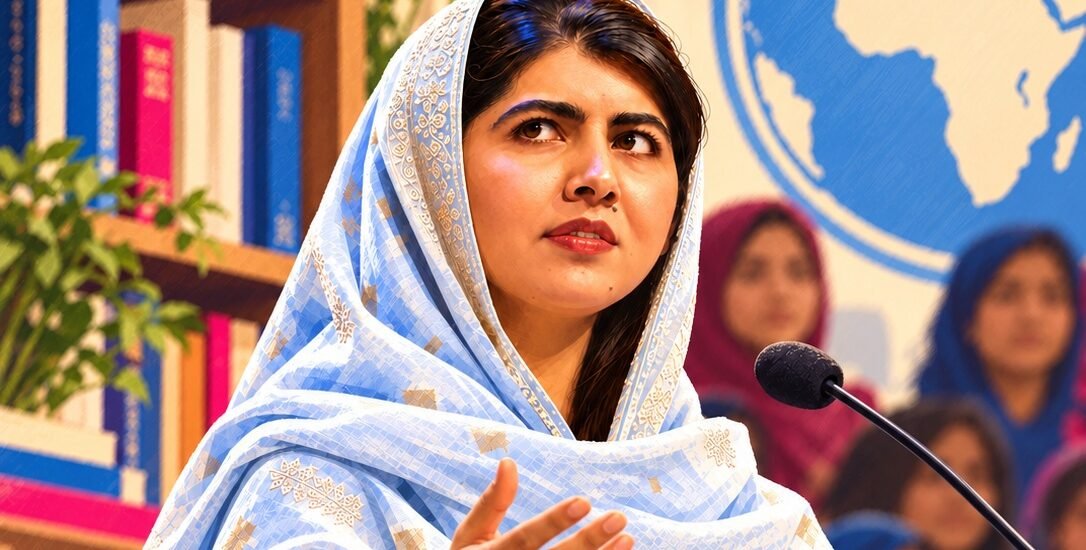
Malala Yousafzai is a Pakistani education activist, institution-builder, author and producer whose public work began before adolescence and developed into a global campaign for girls’ right to complete secondary education. She began speaking publicly against restrictions on girls’ schooling in Pakistan’s Swat Valley while still a child, wrote anonymously for BBC Urdu under Taliban rule, survived an assassination attempt at 15, and continued campaigning after relocating to the United Kingdom. In 2014, at 17, she became the youngest Nobel laureate in history. She now serves as co-founder and Executive Chair of Malala Fund, which uses grantmaking and policy advocacy to strengthen girls’ right to 12 years of education, while her work has expanded into publishing, film and television production, and investment in women’s sports. Nobel Prize
Category: Lead
Field: Education · Girls’ Rights · Philanthropy · Public Advocacy · Media · Social Investment
The education activist who turned an attempt to silence one schoolgirl into a global institution investing in girls, education systems and the right of every girl to complete secondary school.
At a Glance
Yousafzai’s career is often narrated around the 2012 attack that nearly killed her. The chronology is more important than that framing. The activism came first. Before the shooting, she had already spoken publicly about girls’ education, documented life under Taliban rule for BBC Urdu and become a nationally recognised youth advocate in Pakistan. The attack amplified a campaign that already existed. What followed was a second transition: from individual advocacy to institutional capacity. Malala Fund began in 2013 with a $45,000 grant intended to help 40 girls in Swat attend school. By 2025, the organisation reported that its work and partners had reached more than 26 million students, helped secure $7 billion in donor commitments for education and supported 13 million students to continue learning through disruptions including COVID-19 and Afghanistan’s exclusion of girls from secondary school. GlobeNewswire
| Category | Details |
|---|---|
| Born | July 12, 1997 · Mingora, Swat Valley, Pakistan |
| Country | Pakistan |
| Field | Education, girls’ rights, philanthropy, public advocacy, media and social investment |
| Known For | Global advocacy for girls’ education; co-founding Malala Fund; youngest Nobel laureate |
| Education | B.A. Philosophy, Politics and Economics, University of Oxford, Lady Margaret Hall, 2020 |
| Major Roles / Organizations | Malala Fund; United Nations; Extracurricular; Recess Capital |
| Current Role | Co-founder and Executive Chair, Malala Fund |
| First / Record / Milestone | Youngest Nobel Prize laureate in history, awarded the Nobel Peace Prize at age 17 |
| GDT Category | Lead |
Yousafzai also became the youngest-ever United Nations Messenger of Peace when Secretary-General António Guterres appointed her in 2017 with a special focus on girls’ education. In March 2026, she continued in that role, meeting the Secretary-General about the exclusion of Afghan girls and women from education and public life. United Nations
Why She’s a Girls Do That Champion
Malala Yousafzai’s significance is not that one girl became globally famous.
It is that an individual experience was progressively converted into institutional leverage.
Her original problem was direct:
girls in her community were being denied school.
The mechanisms producing that exclusion, however, were larger:
extremist violence,
gender discrimination,
school availability,
education budgets,
teacher shortages,
transport costs,
child marriage,
conflict,
social norms,
and political decisions.
A speech can draw attention to those problems.
It cannot solve all of them.
That requires organizations.
Local expertise.
Money.
Law.
Policy.
Budgets.
Teachers.
Schools.
Data.
Coalitions.
Yousafzai’s work gradually moved into those layers.
Malala Fund now describes its mission not as simply sending individual girls to school, but as strengthening girls’ legal right to secondary education and securing the resources required to make that right usable in practice. Its current grantmaking supports civil-society organisations working on policy, budgets, school re-entry, safe-school systems, female-teacher recruitment and emergency education. Malala Fund
That is a meaningful evolution.
The child activist said:
girls should be allowed to learn.
The institution built around that conviction now asks:
what laws, budgets, organisations and financing structures must exist so that millions of girls can actually do so?
For Girls Do That, that transition is the central story.
Her Story
Swat Valley
Malala Yousafzai was born on July 12, 1997, in Mingora in Pakistan’s Swat Valley.
Her father, Ziauddin Yousafzai, was an educator, school administrator and activist who operated schools and publicly defended education. Her mother, Toor Pekai Yousafzai, had received much less formal education — a contrast that made the gendered distribution of educational opportunity visible inside the family itself.
Malala grew up around classrooms.
Education was not an abstract development issue.
It was part of the household economy, the family’s public work and the structure of daily life.
Then the political environment around that education changed.
When School Became Dangerous
The Pakistani Taliban expanded its control in Swat during Malala’s childhood.
Girls’ schools were attacked and destroyed.
Restrictions were imposed on women’s public lives.
Girls were told they could no longer attend school.
The Nobel Committee records that, as Taliban control expanded from 2008, girls’ schools were burned and Yousafzai began publicly opposing the restrictions. Nobel Prize
For a child who already loved school, the right to attend suddenly became conditional.
That changed education from something she participated in into something she had to defend.
The BBC Diary
In 2009, at 11, Yousafzai began writing anonymously for BBC Urdu about life under Taliban rule.
She used the pseudonym Gul Makai.
The diary documented what political repression looked like at the level of an ordinary schoolgirl:
fear,
school closures,
violence,
uncertainty,
and the possibility that an activity as routine as attending class could disappear.
The writing is important because it preceded the global symbol Malala later became.
She was not commenting retrospectively on a historical event.
She was documenting a system while living inside it. Nobel Prize
She increasingly began speaking under her own name.
A New York Times documentary followed her family’s efforts to defend education in Swat.
By 2011, Archbishop Desmond Tutu had nominated her for the International Children’s Peace Prize, and Pakistan awarded her its National Youth Peace Prize. Malala Fund
Her visibility was increasing.
So was the risk.
October 9, 2012
On October 9, 2012, Malala finished a school examination and boarded the vehicle taking students home.
A Taliban gunman stopped it.
He asked for Malala.
Then he shot her in the head.
She was 15. Malala Fund
The bullet entered the left side of her head and caused extensive injuries.
She was treated initially in Pakistan before being transported to Birmingham, England, for specialist care.
She regained consciousness days later.
Months of treatment and rehabilitation followed.
The assassination attempt is now so central to her public biography that it can obscure an important fact:
The attack did not create Malala’s activism.
It was intended to stop it.
That distinction matters.
The Taliban targeted an activist who was already speaking, publishing and organising around girls’ education.
What changed after the attack was the scale of the audience.
Birmingham
Yousafzai and her family eventually settled in Birmingham.
She resumed school.
The experience created a strange duality.
She had become internationally famous because someone had tried to stop her from receiving an ordinary education.
Then she returned to being a student.
That combination — public symbol and schoolgirl — would define much of her adolescence.
Instead of withdrawing from advocacy, she expanded it.
The First Malala Fund Grant
The first Malala Fund intervention was announced in April 2013.
It was specific and comparatively small.
$45,000.
40 girls.
Ages five to 12.
Swat Valley.
The girls were at risk of remaining in domestic labour or entering the workforce rather than attending school.
The programme would support enrolment, school uniforms, shoes and learning materials while working with families and the community around girls’ education. The organisation receiving the funds was kept confidential for security reasons. GlobeNewswire
Yousafzai described the grant as the happiest moment of her life and set an ambition much larger than the initial project: turn education for 40 girls into education for millions.
The operating logic of Malala Fund would become much more sophisticated over the following decade.
But the first grant established the direction.
Attention would be converted into capital.
Capital would be directed toward girls’ education.
The United Nations
On July 12, 2013 — her 16th birthday — Yousafzai addressed a United Nations Youth Assembly in New York.
It was her first major public speech after the attack.
She argued for universal education rather than retaliation against the people who had attacked her.
Near the end of the address, she delivered the line that became most closely associated with her early advocacy:
“One child, one teacher, one book and one pen can change the world.” UN Web TV
The formulation is deliberately simple.
Education is cumulative.
A teacher influences many students.
A literate child gains access to further knowledge.
Books preserve and distribute ideas.
A school compounds those effects across cohorts.
The fundamental unit may be one child.
The intended outcome is systemic.
I Am Malala
Later in 2013, Yousafzai published I Am Malala, written with journalist Christina Lamb.
The book transformed a widely reported event into a longer historical and personal account of Swat, education, family, extremism and political violence.
It became an international bestseller.
Publishing provided something speeches could not.
A speech travels quickly.
A book preserves context.
That distinction would become increasingly important in Yousafzai’s later work as she expanded from advocacy into media production.
The Nobel Peace Prize
On October 10, 2014, the Norwegian Nobel Committee announced that the Nobel Peace Prize would be shared by Malala Yousafzai and Kailash Satyarthi.
The citation recognised their struggle against the suppression of children and young people and for the right of children to education.
Yousafzai was 17 years old.
She remains the youngest person ever awarded a Nobel Prize in any category. Nobel Prize
The Nobel Prize changed more than her public status.
It provided additional capital.
Yousafzai announced that her prize money would support Malala Fund, beginning with educational infrastructure in Pakistan.
In her Nobel lecture, she made the intended endpoint explicit:
“I will continue this fight until I see every child in school.” Malala Fund
From a Campaign to an Institution
Malala Fund was co-founded by Malala and Ziauddin Yousafzai in 2013.
Its current objective is specific:
every girl should be able to access and complete 12 years of education.
The organization’s work now operates through two principal mechanisms:
grantmaking
and
advocacy.
Its grants support organizations working closest to the barriers preventing girls from completing school.
Its advocacy works on the policies, legal rights, public budgets and international financing structures affecting whether education systems can serve girls at scale. Malala Fund
This means the unit of intervention has changed.
The original grant could fund uniforms and schooling for 40 girls.
A policy change can affect hundreds of thousands.
A national budget can affect millions.
The Education Champion Network
Malala Fund’s principal grantmaking structure is the Education Champion Network.
The organisation funds civil-society groups operating in countries and communities where large numbers of girls are out of school or likely to drop out.
The funding model increasingly emphasizes flexible, multi-year grants rather than short, highly restricted projects.
That matters operationally.
Local organizations often understand the obstacle more precisely than an international funder does.
In one location the problem may be:
transport.
In another:
child marriage.
In another:
lack of female teachers.
In another:
school fees that are technically unofficial but practically unavoidable.
In another:
war.
Flexible capital allows organizations closer to those constraints to determine how the funding should be used. Malala Fund
Malala Fund also aims to direct at least 20% of Education Champion Network funding toward organizations led or governed by girls and young women.
The first major round under its new strategy substantially exceeded that target.
$4.8 Million and Young Women-Led Organizations
In November 2025, Malala Fund announced $4.8 million in grants to 21 organizations working across Pakistan, Nigeria, Brazil, Ethiopia and Tanzania.
Approximately 66% of the funding — $3.17 million — went to young women-led organisations. Malala Fund
The projects addressed different constraints within the same education system.
In Pakistan, partners were tackling hidden schooling costs, damaged infrastructure and female-teacher shortages.
In Nigeria, organizations were working on child marriage, school re-entry for pregnant girls and young mothers, and education-budget accountability.
In Brazil, work included menstrual dignity, gender- and race-responsive education planning and violence prevention.
In Ethiopia, partners focused on safe schools, gender-based violence and conflict-affected students.
In Tanzania, organisations worked on school re-entry and marriage-law reform.
The portfolio demonstrates why “send girls to school” is an insufficient operating strategy.
Girls leave education for different reasons.
A scalable intervention has to work on those reasons.
From 40 Girls to Millions of Students
By the close of Malala Fund’s 2020–2025 strategy, the organization reported that its work had reached more than 26 million students.
It also reported working with partners to unlock $7 billion in donor commitments for education and helping 13 million students continue learning during major disruptions, including COVID-19 and Afghanistan’s post-2021 restrictions on girls’ education. Malala Fund
Across its first decade, Malala Fund awarded more than 400 transformational grants to partner organisations. Malala Fund
In 2026, as the institution transitioned to a new global CEO, Malala Fund reported that $32.5 million in grants had been distributed under the preceding leadership period alone. Malala Fund
The numbers document an important institutional transition.
The original asset was Malala’s voice.
The organization progressively built:
fundraising capacity,
grant-management systems,
country operations,
research,
policy expertise,
local partner networks,
governance,
and global advocacy infrastructure.
That is how an individual campaign becomes an institution.
The 2025–2030 Strategy
Malala Fund entered its next phase with a new five-year strategy.
The organisation aims to distribute $50 million in grants between 2025 and 2030.
Its priorities centre on two systemic outcomes:
strengthening girls’ rights to secondary education
and
securing the resources necessary to make those rights meaningful. Malala Fund
The strategy continues work in Afghanistan, Brazil, Ethiopia, Nigeria, Pakistan and Tanzania, with particularly deep national advocacy in Nigeria and Pakistan. Malala Fund
The distinction between a right and a resource is fundamental.
A country can legally guarantee education.
But if there are:
too few teachers,
unsafe schools,
no transport,
unaffordable materials,
or insufficient public budgets,
the formal right may not translate into attendance.
Malala Fund therefore increasingly treats education as a systems-financing problem as well as a human-rights problem.
Pakistan
Pakistan remains central to the institution’s work.
Malala Fund has been investing there since 2013.
By October 2025, Yousafzai reported that the organization had invested more than $14 million supporting education work in Pakistan. Malala Fund
Current priorities include:
increasing public funding for girls’ secondary education in rural areas,
recruiting more female teachers,
reducing the hidden costs families face when sending girls to school,
and repairing educational infrastructure affected by climate-related disasters. Malala Fund
The progression from the first Swat grant is significant.
The original project helped families afford the immediate cost of schooling.
The current work asks why those costs exist and what government financing structures would reduce them at scale.
Afghanistan
Afghanistan has become one of Malala Fund’s most urgent areas of work.
Since the Taliban returned to power in 2021, girls have been barred from secondary education.
Malala Fund now supports Afghan women-led organizations and education providers delivering alternative learning through:
home-based education,
community schools,
online platforms,
radio,
and television.
Its partners operate programmes with the capacity to reach more than two million girls. One partner, Begum Organization for Women, operates a satellite television channel broadcasting classes for 21 hours a day, reaching girls who may not have reliable internet access or smartphones. Malala Fund
The strategy addresses two separate time horizons.
The immediate problem is:
how do girls continue learning while formal schools remain closed to them?
The longer-term problem is:
how does the international legal and political system respond when a state systematically excludes women and girls from education and public life?
Malala Fund therefore also works with Afghan women activists seeking recognition of gender apartheid as a crime under international law. Malala Fund
Oxford
While leading an increasingly global campaign, Yousafzai continued her own education.
In 2017, she entered Lady Margaret Hall at the University of Oxford to study Philosophy, Politics and Economics.
She graduated in 2020. LMH Oxford
The degree had an unusual symbolic relationship with her public work.
For years, Yousafzai had argued that girls should be able to finish school.
She was simultaneously doing the ordinary work of completing her own education:
lectures,
essays,
examinations,
friendships,
deadlines,
and university life.
That period later became central to a different version of her public story.
Beyond the Symbol
Global advocacy had frozen Yousafzai in public imagination at a very specific age.
Fifteen.
School uniform.
Hospital recovery.
Sixteen.
United Nations speech.
Seventeen.
Nobel Peace Prize.
But she continued ageing.
That created a representational problem.
A human being had become an international symbol before she had finished adolescence.
Her second memoir, Finding My Way, published in October 2025, addresses that distance directly.
Rather than reconstructing the familiar history of the shooting and Nobel Prize, the book focuses on adulthood:
friendship,
university,
anxiety,
trauma,
identity,
romantic relationships,
marriage,
and the process of discovering who she was outside the role the world assigned her. Simon & Schuster
The book therefore performs a different function from I Am Malala.
The first establishes the public history.
The second reclaims the private person living inside it.
Books
| Year | Book | Focus |
|---|---|---|
| 2013 | I Am Malala, with Christina Lamb | Swat, education activism, the Taliban attack and the origins of her global campaign |
| 2017 | Malala’s Magic Pencil | Children’s picture book connecting imagination with social change |
| 2019 | We Are Displaced | Stories of displaced girls and women encountered through her advocacy |
| 2025 | Finding My Way | Adulthood, identity, trauma, Oxford, relationships and life beyond the public symbol |
Finding My Way became an immediate New York Times bestseller and was released in paperback in September 2026. A young-readers edition is scheduled for 2027. Simon & Schuster
Storytelling as Infrastructure
Yousafzai’s expansion into media production is not separate from her advocacy.
It changes the mechanism of distribution.
A policy report primarily reaches policymakers and specialists.
A speech can reach a mass audience for a short period.
A film can place viewers inside another person’s experience for ninety minutes.
That ability to distribute perspective has become another component of Yousafzai’s work.
Extracurricular
In 2021, Yousafzai established the production company Extracurricular and entered a multi-year programming partnership with Apple.
The agreement covered drama, comedy, documentaries, animation and children’s programming. Apple
The company subsequently backed projects that extend beyond Yousafzai’s own biography.
Joyland
Yousafzai served as an executive producer of Saim Sadiq’s Joyland, a Pakistani film exploring family, gender, desire and social expectations.
The film became the first Pakistani feature to premiere at the Cannes Film Festival and won the Un Certain Regard Jury Prize and Queer Palm. It was later shortlisted for the Academy Award for Best International Feature Film. Instinct Productions
Backing the film was significant because it positioned Yousafzai not as the subject of the story, but as someone using access and capital to increase the distribution of another Pakistani filmmaker’s work.
Stranger at the Gate
She also became an executive producer of Stranger at the Gate, Joshua Seftel’s documentary short about an American former Marine who planned an attack on a mosque before developing relationships with members of the Muslim community he intended to target.
The film received an Academy Award nomination for Best Documentary Short Film. Stranger at the Gate
The Last of the Sea Women
In 2024, Yousafzai produced The Last of the Sea Women, directed by Sue Kim.
The Apple Original documentary follows South Korea’s haenyeo, generations of women free divers on Jeju Island whose economic traditions and marine environment face significant pressure.
The film premiered at the Toronto International Film Festival and was released globally on Apple TV in October 2024. Apple
Bread & Roses
Yousafzai also executive produced Bread & Roses, directed by Afghan filmmaker Sahra Mani and produced alongside Jennifer Lawrence and Justine Ciarrocchi.
The documentary follows Afghan women resisting the severe restrictions imposed after the Taliban’s return to Kabul.
Apple released the film globally in November 2024. Apple
This project connects directly to Malala Fund’s policy work in Afghanistan, but uses a different instrument.
The Fund finances education and advocacy.
The film documents women’s lived experience.
Both address the same system from different directions.
Suffs
In 2024, Yousafzai joined the producing team behind the Broadway musical Suffs, written by Shaina Taub and centred on women involved in the American suffrage movement.
The production received six Tony Award nominations. Yousafzai was included among the Broadway producers credited by the Tony Awards. Tony Awards
Selected Screen and Stage Production Work
| Year | Project | Role |
|---|---|---|
| 2022 | Joyland | Executive Producer |
| 2022 | Stranger at the Gate | Executive Producer |
| 2024 | Suffs | Broadway Producer |
| 2024 | The Last of the Sea Women | Producer |
| 2024 | Bread & Roses | Executive Producer |
The portfolio shows a recurring editorial interest in who controls narratives about women, Muslim communities, gender, identity and political participation.
The mechanism is different from grantmaking.
The allocation decision is similar:
which voices receive capital, distribution and an audience?
Assembly
Before Extracurricular, Malala Fund had already begun experimenting with editorial infrastructure through Assembly, a digital publication launched for girls and young women.
By 2021, Apple reported that Assembly had published stories from young women in more than 100 countries and over 20 languages. Apple
The model reflected a principle that later became more explicit in Malala Fund’s grantmaking:
girls should not exist only as subjects of advocacy.
They should also be authors of it.
From Philanthropy to Investment
In 2025, Yousafzai expanded into another institutional model:
private investment.
Together with her husband, Asser Malik, she co-founded Recess Capital, an investment platform focused on women’s sports.
The fund targets investments in professional teams and leagues as well as sports-adjacent businesses, primarily in North America and Europe. Yousafzai serves on its investment committee. Recess Capital
The distinction between Malala Fund and Recess is important.
Malala Fund is nonprofit.
Recess is an investment vehicle.
One allocates philanthropic capital toward education rights.
The other seeks commercial returns while investing in an industry its founders believe has been structurally undercapitalized.
That means Yousafzai is now working through two different capital systems.
Why Women’s Sports?
The connection to education is not incidental.
Girls’ participation in sport is influenced by many of the same systems that affect education:
gender expectations,
school infrastructure,
family resources,
safety,
visibility,
institutional investment,
and whether girls are taught that particular spaces belong to them.
Recess describes women’s sport simultaneously as a rapidly growing commercial market and a mechanism through which women and girls gain opportunity, representation and participation. Recess Capital
Yousafzai’s role has therefore expanded again.
Activist.
Philanthropist.
Institutional chair.
Producer.
Investor.
The instruments change.
The underlying question remains closely related:
who receives the resources required to participate?
Malala Fund Is No Longer Malala
One measure of successful institution-building is whether an organisation can become larger than the personality that created it.
Malala Fund has been moving in that direction deliberately.
It has professional boards.
National leadership.
Staff across multiple countries.
Independent executives.
Audited financial statements.
Grantmaking systems.
Policy teams.
A Young Women Advisory Council.
And a formal succession process.
In April 2026, Nabila Aguele became Malala Fund’s global Chief Executive Officer, becoming the first person to lead the global organisation from Nigeria. Malala Fund
Yousafzai remains Executive Chair.
But she is not operating the institution as a personality-driven founder-CEO.
That governance distinction matters.
A movement may begin with one recognizable voice.
A durable institution needs distributed leadership.
The Power and Limits of Being a Symbol
Yousafzai’s own thinking about change has also evolved.
At 16, her United Nations speech offered one of the clearest expressions of individual agency:
one child,
one teacher,
one book,
one pen.
Ten years later, she added a qualification.
Speaking in Nigeria in 2023, she argued that no child, president, prime minister, teacher, activist or parent can change the world alone.
What one person can do is begin change. UNSDG
That progression mirrors the institutional development of her own work.
Individual courage began the campaign.
Collective infrastructure made it scalable.
What Malala Built
| System | Problem | Intervention |
|---|---|---|
| Early public advocacy | Girls in Swat were being denied access to school | Public speaking, journalism and documentation |
| Malala Fund | Individual advocacy could not address education barriers at scale | Built a permanent grantmaking and advocacy institution |
| Education Champion Network | Local organizations closest to barriers often lack sustained capital | Flexible multi-year funding for civil-society organizations |
| Policy advocacy | Formal access to education depends on laws, budgets and financing | Works on secondary-education rights, national budgets and global finance |
| Emergency education | Conflict, climate disasters and public-health emergencies interrupt schooling | Rapid grants and alternative learning programmes |
| Afghanistan Initiative | Girls are excluded from secondary schools | Supports home, community, digital, radio and television education plus legal advocacy |
| Assembly | Girls are frequently represented without controlling the narrative | Editorial platform for girls’ own stories |
| Extracurricular | Advocacy messages compete for attention in conventional policy channels | Film, television and stage production |
| Recess Capital | Women’s sports remains comparatively undercapitalized | Commercial investment in teams, leagues and sports-related businesses |
The systems are different.
Their operating principle is similar:
move resources toward girls and women who have historically been expected to participate with less.
From Access to Agency
Education advocacy is often framed around school enrolment.
Malala Fund’s current language moves further.
Its stated goal is that girls should be able to learn and choose their own futures. Malala Fund
That final phrase changes the purpose of education.
School is not only a mechanism for producing workers.
It expands decision-making capacity.
A girl who completes secondary school has more information and potentially more leverage over:
further education,
employment,
income,
marriage,
family formation,
health,
migration,
political participation,
and the kind of life she intends to build.
The central asset is therefore not simply education.
It is agency.
The Scale of the Remaining Problem
Malala’s prominence can create the impression that girls’ education is an advocacy problem the world has already recognized and is steadily solving.
Current numbers suggest otherwise.
Malala Fund reports that more than 122 million girls remain out of school globally. Malala Fund
The remaining barriers are increasingly concentrated among girls affected by:
poverty,
conflict,
forced displacement,
gender discrimination,
early marriage,
climate shocks,
weak public infrastructure,
and chronic underinvestment in education.
The next phase of the problem is therefore more difficult than awareness.
Few global leaders now need to be told that girls should receive an education.
The question is whether laws, budgets and institutions will make that principle operational.
What Changed Because She Spoke
The systems question around Malala Yousafzai is not:
Did one girl change the world?
Her own later analysis rejects that formulation.
The more useful question is:
What infrastructure exists today because one girl began speaking?
A global education institution exists.
Hundreds of local organisations have received funding.
Millions of students have been reached through Malala Fund and its partners.
Billions of dollars in education commitments have been influenced.
Young women-led organisations now receive multi-year capital.
Girls prohibited from entering Afghan secondary schools can access education through alternative systems supported by the Fund’s partners.
Films by Pakistani and Afghan storytellers have received additional global distribution.
Women’s sports now sits inside another capital vehicle carrying her name, network and investment thesis.
The progression is not:
girl → icon.
It is:
girl → advocate → platform → institution → distributed capital → other leaders.
That is the larger measure of the work.
Milestones
| Year | Milestone |
|---|---|
| 1997 | Born July 12 in Mingora, Pakistan |
| 2008 | Begins speaking publicly about girls’ right to education as Taliban restrictions expand in Swat |
| 2009 | Writes anonymously for BBC Urdu under the pseudonym Gul Makai |
| 2009 | Appears in documentary reporting about her family’s education advocacy in Swat |
| 2011 | Nominated for International Children’s Peace Prize and receives Pakistan’s National Youth Peace Prize |
| October 9, 2012 | Shot by a Taliban gunman while returning home from school |
| 2012–2013 | Undergoes treatment and rehabilitation in the United Kingdom |
| April 2013 | First Malala Fund grant provides $45,000 to help 40 girls attend school in Swat |
| July 12, 2013 | Addresses United Nations Youth Assembly on her 16th birthday |
| 2013 | Publishes I Am Malala |
| 2013 | Co-founds Malala Fund with Ziauddin Yousafzai |
| 2014 | Awarded Nobel Peace Prize at 17, becoming youngest Nobel laureate in history |
| 2015 | Malala Fund expands its education work across multiple countries and crisis contexts |
| 2017 | Begins PPE degree at Lady Margaret Hall, University of Oxford |
| 2017 | Appointed youngest-ever United Nations Messenger of Peace |
| 2017 | Publishes Malala’s Magic Pencil |
| 2018 | Returns to Pakistan for the first time since the 2012 attack |
| 2019 | Publishes We Are Displaced |
| 2020 | Graduates from Oxford University with degree in Philosophy, Politics and Economics |
| 2021 | Establishes Extracurricular and signs programming partnership with Apple |
| 2022 | Executive produces Joyland and Stranger at the Gate |
| 2024 | Produces Broadway’s Suffs |
| 2024 | Produces The Last of the Sea Women |
| 2024 | Executive produces Bread & Roses |
| 2025 | Malala Fund reports work reaching more than 26 million students to date |
| 2025 | Malala Fund launches 2025–2030 strategy aiming to distribute $50 million in grants |
| 2025 | $4.8 million Education Champion Network round directs 66% of funding to young women-led organisations |
| 2025 | Co-founds women’s sports investment platform Recess Capital |
| 2025 | Publishes Finding My Way |
| 2026 | Malala Fund appoints Nabila Aguele as global CEO while Yousafzai continues as Executive Chair |
| 2026 | Continues UN and Malala Fund advocacy on Afghan girls’ education and recognition of gender apartheid |
| 2026 | Returns to Pakistan during Malala Fund’s continuing work with girls, activists and education partners |
In Her Own Words
“One child, one teacher, one book and one pen can change the world.”
— Malala Yousafzai, United Nations Youth Assembly, 2013 UN Web TV
“I will continue this fight until I see every child in school.”
— Malala Yousafzai, Nobel Lecture, 2014 Malala Fund
“Girls understand the power of education.”
— Malala Yousafzai, Malala Fund Malala Fund
Read · Watch · Listen
Read
Finding My Way — Malala Yousafzai
Her 2025 memoir covers the years after the world already knew her name: university, trauma, friendship, relationships, identity and learning to construct an adult life beyond the public symbol.
Finding My Way — Simon & Schuster
Malala’s Story — Malala Fund
A primary chronology of her childhood, activism, attack, recovery and subsequent advocacy.
Malala Fund 2025 Annual Report
Documents the end of the organisation’s 2020–2025 strategy, including reported reach of more than 26 million students, $7 billion in education commitments and emergency-learning support for 13 million students.
Malala Fund 2025 Annual Report
2025–2030 Strategy
Explains the organisation’s shift toward strengthening legal rights, increasing education resources and distributing $50 million in grants over five years.
The Leaders Who Give Me Hope — Malala Fund
Watch
Malala Yousafzai Addresses the United Nations Youth Assembly — 2013
Her first major international speech after the assassination attempt.
Bread & Roses
Sahra Mani’s documentary follows Afghan women resisting the restrictions imposed on their lives after the Taliban returned to power. Yousafzai is an executive producer through Extracurricular.
The Last of the Sea Women
Sue Kim’s documentary follows South Korea’s haenyeo divers and the intergenerational effort to sustain their culture, livelihoods and marine environment. Yousafzai is a producer.
The Last of the Sea Women — Apple TV
Listen
Finding My Way — Audiobook
The unabridged memoir is read by Yousafzai herself.
Finding My Way — Simon & Schuster Audio
Go Deeper
Malala Fund
Grantmaking, advocacy, research, financial reporting and girls’ education programmes.
Education Champion Network
The institution’s principal grantmaking infrastructure for locally led girls’ education work.
Afghanistan Initiative
Alternative education, Afghan women-led organisations and advocacy concerning girls’ exclusion from secondary education.
Recess Capital
Yousafzai and Asser Malik’s investment platform focused on women’s sports and sports-adjacent industries.
Malala Yousafzai — Nobel Prize
Official Nobel biography, prize citation and Nobel lecture.
Sources & Further Reading
APA 7th Edition
Apple. (2021, March 8). Apple TV+ announces programming partnership with Nobel laureate Malala Yousafzai.
Apple Newsroom
Apple TV Press. (2024). Bread & Roses.
Apple TV Press
Apple TV Press. (2024). The Last of the Sea Women.
Apple TV Press
Lady Margaret Hall, University of Oxford. (2026, February 9). New portrait celebrates LMH alumna Malala Yousafzai.
Lady Margaret Hall
Malala Fund. (n.d.). About Malala Fund.
Malala Fund
Malala Fund. (n.d.). Advocacy.
Malala Fund — Advocacy
Malala Fund. (n.d.). Afghanistan.
Malala Fund — Afghanistan
Malala Fund. (n.d.). Grantmaking.
Malala Fund — Grantmaking
Malala Fund. (n.d.). Malala’s story.
Malala’s Story
Malala Fund. (2025, April 23). The leaders who give me hope — and how our new strategy backs them.
Malala Fund
Malala Fund. (2025, September 15). Malala Fund publishes its 2025 annual report.
Malala Fund Annual Report
Malala Fund. (2025, November 19). Malala Fund announces new investment of $4.8M in girls’ education — with 66% going to young women-led organisations.
Malala Fund
Malala Fund. (2026, March 30). Malala Fund appoints Nabila Aguele as new CEO.
Malala Fund
Nobel Prize Outreach. (2014). Malala Yousafzai — Facts.
NobelPrize.org
Recess Capital. (n.d.). Investing to win and transform.
Recess Capital
Simon & Schuster. (2025). Finding My Way: A memoir.
Simon & Schuster
United Nations. (2013, July 12). Malala Yousafzai addresses United Nations Youth Assembly. YouTube
United Nations. (2017, April 10). Secretary-General designates Malala youngest-ever United Nations Messenger of Peace.
United Nations
Vital Voices Global Partnership. (2013, April 4). Malala Yousafzai announces first grant from Malala Fund. GlobeNewswire
Pioneer the Path, Then Widen It
Explore the Girls Do That Lead Collection, celebrating women and girls whose work changes what is possible — and expands access for those who follow.
Every collection helps fund a Girls Do That Club for the next generation.