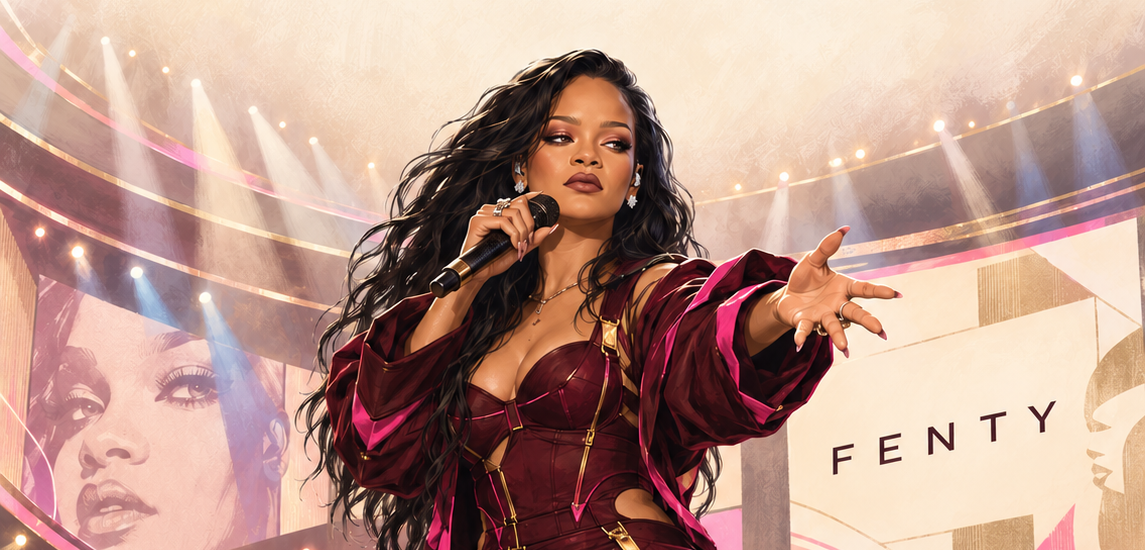
Robyn Rihanna Fenty is a Barbadian singer, songwriter, performer, entrepreneur, philanthropist and National Hero whose career has become a case study in how cultural influence can be converted into ownership. Born in Saint Michael, Barbados, and raised in Bridgetown, she was still a teenager when American producer Evan Rogers heard her sing during a visit to the island. She recorded demos, moved to the United States at 16 and auditioned for Def Jam, where Jay-Z—then the label’s president—helped sign her. In 2005, the 17-year-old introduced herself to the world with the dancehall-pop single “Pon de Replay.” Twenty years later, Rihanna had accumulated nine Grammy Awards, 14 Billboard Hot 100 No. 1s, one of modern pop’s deepest hit catalogues, multiple global consumer brands and a fortune Forbes estimated at approximately $1 billion in 2026.
Category: Builder
Field: Music · Beauty · Fashion · Entrepreneurship · Philanthropy
The Barbadian superstar who turned music into cultural power, cultural power into ownership, and her surname into a global business ecosystem.
At a Glance
Rihanna’s transformation is remarkable partly because she did not abandon one career to begin another. She accumulated leverage. Music created audience. Fashion established taste. Collaborations taught product. Creative-director roles moved her closer to design. Then ownership changed the economics completely. In 2017, she launched Fenty Beauty with LVMH-backed Kendo, opening with 40 foundation shades and forcing the beauty industry to reconsider whom “mainstream” beauty was designed for. Savage X Fenty followed in 2018; an LVMH luxury maison in 2019; Fenty Skin in 2020; fragrance and haircare after that. Forbes declared her a billionaire in 2021, estimating that the overwhelming majority of her fortune came not from touring or record sales, but from equity in the businesses she had built.
| Born | February 20, 1988 — Saint Michael, Barbados |
| Country | Barbados |
| Field | Music, beauty, fashion, entrepreneurship and philanthropy |
| Known For | “Umbrella,” “We Found Love,” “Diamonds,” “Work,” ANTI, Fenty Beauty, Savage X Fenty |
| Education | Charles F. Broome Memorial Primary School; Combermere School, Barbados; left secondary school as a teenager to pursue music |
| Major Roles / Organizations | Recording artist; Founder, Fenty Beauty; Founder & Brand Visionary, Savage X Fenty; Founder, Clara Lionel Foundation; former CEO & Artistic Director, Fenty maison; Creative Director, FENTY x PUMA |
| Music Milestones | 9 Grammy Awards; 34 Grammy nominations; 14 Billboard Hot 100 No. 1s; first act to exceed 100 million RIAA single certifications |
| Business Milestone | Forbes estimated her a billionaire in 2021, primarily through ownership of Fenty Beauty |
| National Milestone | Named the 11th National Hero of Barbados in 2021 |
| GDT Category | Builder |
Rihanna remains one of popular music’s most commercially dominant artists despite having released only eight studio albums. By 2025, she had accumulated 64 Billboard Hot 100 entries, 32 top-ten hits and 14 No. 1s. The Recording Academy credits her with nine Grammy wins, while Guinness records her as the first artist to surpass 100 million RIAA single certifications in the United States.
Why She’s a Girls Do That Champion
Rihanna’s story becomes much more interesting when we stop telling it as:
girl becomes famous → famous girl launches makeup → famous girl becomes billionaire.
That skips the actual work.
The real progression is closer to:
Talent → audience → cultural authority → collaboration → product knowledge → negotiating leverage → ownership → scale.
At 17, Rihanna was primarily the product.
A record label selected songs, packaged an image and distributed her music. Her job was to perform.
Over time, she became increasingly involved in deciding what Rihanna sounded like, looked like and represented.
Then something else happened.
She learned that cultural influence could travel beyond music.
Brands wanted access to her taste.
At first, companies paid for her face.
Then they asked for her input.
Then they gave her creative-director responsibilities.
Eventually, she stopped merely helping other companies sell products and began owning meaningful pieces of the companies selling them.
That progression is the central GDT lesson.
Fame made Rihanna valuable. Ownership made Rihanna wealthy.
And she did not create Fenty Beauty by simply printing her name on an existing cosmetic line. The founding proposition addressed a real market failure: women with darker complexions routinely had dramatically fewer foundation options than lighter-skinned consumers. Fenty Beauty entered the market with 40 shades at launch, treated inclusion as product architecture rather than advertising language, and triggered what became known as the “Fenty Effect” as competitors rapidly widened their shade ranges.
Even her unsuccessful ventures matter.
The Fenty luxury fashion house did not work commercially and was suspended less than two years after launch. Rihanna did not cease being a Builder because one build failed. Capital and attention shifted toward businesses with stronger product-market fit: beauty, skincare and lingerie.
That is entrepreneurship too.
Girls Do That chose Rihanna because she shows girls that creativity can become intellectual property, influence can become negotiating power, and the biggest economic shift often happens when you move from being paid to represent value to owning the thing that creates it.
Her Story
Barbados Before the Brand
Before Fenty became a beauty label, lingerie company, fashion maison or sneaker collaboration, it was simply Rihanna’s surname.
Robyn Rihanna Fenty was born in Saint Michael, Barbados, on February 20, 1988.
She attended Charles F. Broome Memorial Primary School and later Combermere School, one of Barbados’ best-known secondary schools. She was also a member of the Barbados Cadet Corps.
Music was already becoming serious.
In 2003, Rihanna and two school friends formed a girl group. The trio received an informal audition with American producer Evan Rogers, who was visiting Barbados.
Rogers noticed Rihanna.
She began travelling between Barbados and the United States to record demo material with Rogers and Carl Sturken.
Eventually, Rihanna left school and moved to the United States to pursue music full-time.
She was sixteen.
“Pon de Replay”
The demo eventually reached Def Jam.
Rihanna auditioned for Jay-Z, who had recently become president of the label.
She was signed in 2005.
Then came:
“Pon de Replay.”
The song sounded like the version of Rihanna the industry first believed it understood.
Young.
Caribbean.
Pretty.
Danceable.
Accessible.
The title itself drew from Bajan and Caribbean speech: essentially asking the DJ to play the song again.
Released in 2005, “Pon de Replay” reached No. 2 on the Billboard Hot 100.
She was seventeen.
Her debut album, Music of the Sun, followed that August.
The album leaned visibly into Rihanna’s island identity—dancehall, reggae, R&B and Caribbean pop.
And this early Rihanna is important.
Because twenty years of retrospective iconography can make it easy to forget that Rihanna did not arrive fully formed as Bad Gal RiRi.
She arrived as a teenage pop newcomer.
Long hair.
Low-rise jeans.
Crop tops.
Dancehall choreography.
“Pon de Replay.”
“If It’s Lovin’ That You Want.”
Bright Caribbean imagery.
The business empire came much, much later.
A Girl Like Me
Rihanna’s second album arrived less than a year after her first.
A Girl Like Me was released in 2006.
Its lead single, “SOS,” became her first Billboard Hot 100 No. 1. “Unfaithful” demonstrated that she could carry a dramatic ballad; “Break It Off” with Sean Paul kept her Caribbean musical identity visible.
The pace is important.
From 2005 through 2012, Rihanna released seven studio albums in eight years.
That is an extraordinary industrial pace.
There was almost always another Rihanna single.
Another feature.
Another video.
Another album.
Another visual era.
Another tour.
Another collaboration.
The ubiquity was part of the strategy whether or not it was consciously designed that way.
Rihanna was becoming embedded inside global popular culture.
Then the Good Girl Went Bad
The real transformation arrived in 2007.
Good Girl Gone Bad was more than another album title.
It was a repositioning.
The Caribbean teen-pop styling was stripped back.
The bob appeared.
The fashion sharpened.
The music moved deeper into pop, dance, R&B and electronic production.
And then Rihanna opened an umbrella.
“Umbrella” changed the scale of the career.
The Jay-Z-assisted single became a global phenomenon and earned Rihanna her first Grammy Award for Best Rap/Sung Collaboration.
But Good Girl Gone Bad did not depend on one song.
It produced:
“Umbrella.”
“Shut Up and Drive.”
“Don’t Stop the Music.”
“Hate That I Love You.”
Then the Reloaded edition added:
“Take a Bow.”
“Disturbia.”
And the Maroon 5 collaboration:
“If I Never See Your Face Again.”
Suddenly Rihanna was not merely a promising young singer.
She was a hit-delivery system.
Rihanna Learns Reinvention
A useful way to understand Rihanna’s musical career is that she rarely stayed inside one genre long enough to become trapped by it.
Dancehall introduced her.
But dancehall did not define the boundary.
She moved through:
pop.
R&B.
EDM.
hip-hop.
rock.
reggae.
dubstep.
electropop.
ballads.
Caribbean music.
And increasingly, combinations of all of them.
Apple Music describes this period as Rihanna moving beyond the sunny Caribbean pop of her debut toward increasingly ambitious combinations of R&B, club music, hip-hop and rock.
That musical flexibility later became one of her greatest commercial assets.
Fenty has no single visual aesthetic either.
Rihanna had spent a decade teaching audiences that change itself was part of the brand.
Rated R: Darkness and Control
Then came 2009.
Following the widely publicized assault by Chris Brown, Rihanna returned with Rated R.
The album was darker.
Colder.
Harder.
Less interested in pleasing.
“Russian Roulette.”
“Wait Your Turn.”
“Hard.”
“Rude Boy.”
“Te Amo.”
“Rockstar 101.”
“Fire Bomb.”
It was a crucial evolution because Rihanna’s persona stopped feeling like something simply styled around her.
The attitude began to feel authored.
“Rude Boy” eventually became another Hot 100 No. 1.
And Rihanna’s public identity hardened into something the later businesses would inherit:
irreverent, sensual, funny, fashion-forward, direct and almost impossible to embarrass.
Loud: Pop Dominance
If Rated R was dark, Loud exploded in colour.
Released in 2010, the album produced a ridiculous sequence of hits:
“Only Girl (In the World).”
“What’s My Name?”
“S&M.”
“Cheers (Drink to That).”
“California King Bed.”
“Man Down.”
Meanwhile Rihanna was appearing on Eminem’s “Love the Way You Lie.”
In 2010 alone, Rihanna became the only female artist at the time to score four U.S. Hot 100 No. 1s in a single calendar year: “Rude Boy,” “Love the Way You Lie,” “What’s My Name?” and “Only Girl (In the World).”
She was no longer simply participating in pop culture.
She was occupying enormous amounts of it.
“We Found Love”
Talk That Talk followed in 2011.
And then came one of the defining records of the EDM-pop era:
“We Found Love.”
Produced by Calvin Harris, the track spent 10 weeks at No. 1 on the Billboard Hot 100, Rihanna’s longest-running U.S. No. 1.
The album also produced:
“Where Have You Been.”
“You da One.”
“Talk That Talk.”
“Birthday Cake.”
And another crucial Drake collaboration had already arrived through “Take Care.”
The catalogue was becoming almost absurdly dense.
Unapologetic
In 2012 came Unapologetic.
Its title again functioned almost like a personal manifesto.
The album opened with the aggressive “Phresh Out the Runway” and moved through trap, dance, R&B and pop.
Then it gave Rihanna two songs at opposite emotional extremes.
“Diamonds.”
and
“Stay.”
“Diamonds” became her twelfth Billboard Hot 100 No. 1.
“Stay,” featuring Mikky Ekko, stripped away almost everything except voice, piano and vulnerability.
That versatility mattered.
Rihanna could credibly deliver “Pour It Up” and “Stay” on the same album.
She could appear on Eminem records, Drake records, Coldplay records, Kanye West records, Nicki Minaj records and Calvin Harris records without sounding like she had wandered accidentally onto someone else’s song.
Her voice had become a genre-translating asset.
Seven Albums in Eight Years
It is worth stopping here.
By the end of 2012, Rihanna was 24 years old.
She had already released:
Music of the Sun.
A Girl Like Me.
Good Girl Gone Bad.
Rated R.
Loud.
Talk That Talk.
Unapologetic.
Seven albums.
The catalogue was already deeper than many artists build across an entire career.
And she was not finished.
The Transition Years
Rihanna slowed the album cycle after Unapologetic.
But the singles continued.
“The Monster” with Eminem.
“Can’t Remember to Forget You” with Shakira.
“FourFiveSeconds” with Kanye West and Paul McCartney.
“Bitch Better Have My Money.”
“American Oxygen.”
“This Is What You Came For.”
And behind the music, something important was changing.
Rihanna left Def Jam and moved to Roc Nation, while releases increasingly came through her own Westbury Road Entertainment structure. Apple Music notes that the move preceded greater creative control over what became ANTI.
She had spent her teens and early twenties proving she could deliver hits.
Now she could afford to make people wait.
ANTI
ANTI arrived in 2016.
It did not sound like an album designed by committee to manufacture seven radio singles.
That was the point.
“Consideration.”
“James Joint.”
“Kiss It Better.”
“Work.”
“Desperado.”
“Woo.”
“Needed Me.”
“Yeah, I Said It.”
“Same Ol’ Mistakes.”
“Never Ending.”
“Love on the Brain.”
“Higher.”
“Close to You.”
The album felt looser, stranger and more self-directed than the Rihanna records that preceded it.
“Work,” featuring Drake, became her 14th Billboard Hot 100 No. 1.
“Needed Me” and “Love on the Brain” became enduring hits.
Then something almost unheard of happened for a pop star at Rihanna’s level.
She stopped releasing albums.
Not forever.
But long enough that an entire generation began asking where R9 was.
And the reason that matters to this profile is that the pause exposed something important:
Rihanna no longer needed music to be her only economic engine.
She had started building others.
Every Rihanna Song
The catalogue below covers 164 distinct officially released songs featuring a credited Rihanna vocal through September 2026: studio-album tracks, deluxe tracks, soundtrack recordings, charity releases, standalone singles, co-leads and songs on which she appears as a featured artist.
Radio edits, instrumental versions, remasters and dance/club mixes are not counted as separate compositions. Official remixes that materially add newly credited performers are listed separately immediately after the main catalogue. The catalogue is cross-checked against Rihanna’s released-song index and her current digital catalogue, including 2022’s “Lift Me Up” and “Born Again” and 2025’s “Friend of Mine.”
| Year | Song | Rihanna credit | Release / Project |
|---|---|---|---|
| 2010 | All of the Lights | Featured with Kid Cudi on Kanye West track | My Beautiful Dark Twisted Fantasy |
| 2015 | American Oxygen | Lead | Standalone single |
| 2015 | As Real as You and Me | Lead | Home |
| 2013 | Bad (Remix) | Featured on Wale track | The Gifted |
| 2009 | Bad Girl | Lead feat. Chris Brown | Confessions of a Shopaholic |
| 2020 | Believe It | Featured on PARTYNEXTDOOR track | PARTYMOBILE |
| 2011 | Birthday Cake | Lead | Talk That Talk |
| 2015 | Bitch Better Have My Money | Lead | Standalone single |
| 2006 | Boom Boom | Featured on Cham track | Ghetto Story |
| 2022 | Born Again | Lead | Black Panther: Wakanda Forever |
| 2006 | Break It Off | Lead feat. Sean Paul | A Girl Like Me |
| 2007 | Breakin’ Dishes | Lead | Good Girl Gone Bad |
| 2010 | California King Bed | Lead | Loud |
| 2014 | Can’t Remember to Forget You | Featured on Shakira track | Shakira. |
| 2010 | Cheers (Drink to That) | Lead | Loud |
| 2010 | A Child Is Born | Lead | Now That’s What I Call Christmas! 4 |
| 2016 | Close to You | Lead | ANTI |
| 2011 | Cockiness (Love It) | Lead | Talk That Talk |
| 2009 | Cold Case Love | Lead | Rated R |
| 2010 | Complicated | Lead | Loud |
| 2016 | Consideration | Lead feat. SZA | ANTI |
| 2006 | Coulda Been the One | Lead | A Girl Like Me bonus |
| 2015 | Counterfeit | Featured with Kelly Rowland & Wiz Khalifa on Chris Brown track | Before the Party |
| 2006 | Crazy Little Thing Called Love | Lead feat. J-Status | A Girl Like Me |
| 2007 | Cry | Lead | Good Girl Gone Bad bonus |
| 2015 | Dancing in the Dark | Lead | Home |
| 2006 | Dem Haters | Lead feat. Dwane Husbands | A Girl Like Me |
| 2016 | Desperado | Lead | ANTI |
| 2012 | Diamonds | Lead | Unapologetic |
| 2008 | Disturbia | Lead | Good Girl Gone Bad: Reloaded |
| 2011 | Do Ya Thang | Lead | Talk That Talk bonus |
| 2007 | Don’t Stop the Music | Lead | Good Girl Gone Bad |
| 2015 | Drop That | Lead | Home |
| 2011 | Drunk on Love | Lead | Talk That Talk |
| 2010 | Fading | Lead | Loud |
| 2016 | Famous | Featured on Kanye West track | The Life of Pablo |
| 2011 | Farewell | Lead | Talk That Talk |
| 2006 | Final Goodbye | Lead | A Girl Like Me |
| 2009 | Fire Bomb | Lead | Rated R |
| 2007 | First Time | Featured on Fabolous track | From Nothin’ to Somethin’ |
| 2010 | Fly | Featured on Nicki Minaj track | Pink Friday |
| 2011 | Fool in Love | Lead | Talk That Talk bonus |
| 2015 | FourFiveSeconds | Co-lead with Kanye West & Paul McCartney | Standalone single |
| 2025 | Friend of Mine | Lead | Smurfs Movie Soundtrack |
| 2009 | G4L | Lead | Rated R |
| 2012 | Get It Over With | Lead | Unapologetic |
| 2006 | A Girl like Me | Lead | A Girl Like Me |
| 2007 | Good Girl Gone Bad | Lead | Good Girl Gone Bad |
| 2016 | Goodnight Gotham | Lead | ANTI bonus |
| 2012 | Half of Me | Lead | Unapologetic bonus |
| 2009 | Hard | Lead feat. Jeezy | Rated R |
| 2007 | Hate That I Love You | Lead feat. Ne-Yo | Good Girl Gone Bad |
| 2008 | Hate That I Love You — Spanglish Version | Lead feat. David Bisbal | Good Girl Gone Bad: Reloaded |
| 2007 | Haunted | Lead | Good Girl Gone Bad bonus |
| 2005 | Here I Go Again | Lead feat. J-Status | Music of the Sun |
| 2016 | Higher | Lead | ANTI |
| 2009 | Hole in My Head | Lead feat. Justin Timberlake | Rated R bonus |
| 2006 | The Hotness | Lead feat. Shontelle | Save the Last Dance 2 |
| 2005 | Hypnotized | Lead | Music of the Sun bonus |
| 2008 | If I Never See Your Face Again | Featured on Maroon 5 track | Good Girl Gone Bad: Reloaded / It Won’t Be Soon Before Long |
| 2005 | If It’s Lovin’ That You Want | Lead | Music of the Sun |
| 2006 | If It’s Lovin’ That You Want (Part 2) | Lead feat. Cory Gunz | A Girl Like Me |
| 2006 | It Just Don’t Feel Like Xmas (Without You) | Lead | Now That’s What I Call Christmas! 3 |
| 2016 | James Joint | Lead | ANTI |
| 2012 | Jump | Lead | Unapologetic |
| 2008 | Just Stand Up! | Ensemble vocalist | Charity single |
| 2016 | Kiss It Better | Lead | ANTI |
| 2006 | Kisses Don’t Lie | Lead | A Girl Like Me |
| 2009 | The Last Song | Lead | Rated R |
| 2005 | The Last Time | Lead | Music of the Sun |
| 2007 | Lemme Get That | Lead | Good Girl Gone Bad |
| 2017 | Lemon | Featured on N.E.R.D. track | No One Ever Really Dies |
| 2005 | Let Me | Lead | Music of the Sun |
| 2022 | Lift Me Up | Lead | Black Panther: Wakanda Forever |
| 2008 | Live Your Life | Featured on T.I. track | Paper Trail |
| 2007 | Livin’ a Lie | Featured on The-Dream track | Love Hate |
| 2012 | Lost in Paradise | Lead | Unapologetic |
| 2016 | Love on the Brain | Lead | ANTI |
| 2010 | Love the Way You Lie | Featured on Eminem track | Recovery |
| 2010 | Love the Way You Lie (Part II) | Lead feat. Eminem | Loud |
| 2012 | Love Without Tragedy / Mother Mary | Lead | Unapologetic |
| 2012 | Loveeeeeee Song | Lead feat. Future | Unapologetic |
| 2017 | LOYALTY. | Featured on Kendrick Lamar track | DAMN. |
| 2009 | Mad House | Lead | Rated R |
| 2010 | Man Down | Lead | Loud |
| 2006 | A Million Miles Away | Lead | A Girl Like Me |
| 2013 | The Monster | Featured on Eminem track | The Marshall Mathers LP 2 |
| 2005 | Music of the Sun | Lead | Music of the Sun |
| 2016 | Needed Me | Lead | ANTI |
| 2016 | Never Ending | Lead | ANTI |
| 2012 | No Love Allowed | Lead | Unapologetic |
| 2005 | Now I Know | Lead | Music of the Sun |
| 2012 | Nobody’s Business | Lead feat. Chris Brown | Unapologetic |
| 2016 | Nothing Is Promised | Co-lead with Mike WiLL Made-It | Ransom 2 |
| 2012 | Numb | Lead feat. Eminem | Unapologetic |
| 2008 | Numba 1 (Tide Is High) | Featured on Kardinal Offishall track | Not 4 Sale |
| 2005 | The One | Featured on Memphis Bleek track | 534 |
| 2010 | Only Girl (In the World) | Lead | Loud |
| 2009 | Photographs | Lead feat. will.i.am | Rated R |
| 2012 | Phresh Out the Runway | Lead | Unapologetic |
| 2005 | Pon de Replay | Lead | Music of the Sun |
| 2016 | Pose | Lead | ANTI bonus |
| 2012 | Pour It Up | Lead | Unapologetic |
| 2011 | Princess of China | Featured with Coldplay | Mylo Xyloto |
| 2006 | P.S. (I’m Still Not Over You) | Lead | A Girl Like Me |
| 2007 | Push Up on Me | Lead | Good Girl Gone Bad |
| 2007 | Question Existing | Lead | Good Girl Gone Bad |
| 2010 | Raining Men | Lead feat. Nicki Minaj | Loud |
| 2011 | Red Lipstick | Lead | Talk That Talk bonus |
| 2010 | Redemption Song | Lead | Charity recording |
| 2007 | Rehab | Lead | Good Girl Gone Bad |
| 2012 | Right Now | Lead feat. David Guetta | Unapologetic |
| 2011 | Roc Me Out | Lead | Talk That Talk |
| 2009 | Rockstar 101 | Lead feat. Slash | Rated R |
| 2007 | Roll It | Featured with Shontelle on J-Status track | The Beginning |
| 2009 | Rude Boy | Lead | Rated R |
| 2009 | Run This Town | Featured with Kanye West on Jay-Z track | The Blueprint 3 |
| 2005 | Rush | Lead feat. Kardinal Offishall | Music of the Sun |
| 2009 | Russian Roulette | Lead | Rated R |
| 2010 | S&M | Lead | Loud |
| 2016 | Same Ol’ Mistakes | Lead | ANTI |
| 2007 | Say It | Lead | Good Girl Gone Bad |
| 2017 | Selfish | Featured on Future track | HNDRXX |
| 2006 | Selfish Girl | Lead | A Girl Like Me |
| 2007 | Sell Me Candy | Lead | Good Girl Gone Bad |
| 2016 | Sex with Me | Lead | ANTI bonus |
| 2005 | Should I? | Lead feat. J-Status | Music of the Sun bonus |
| 2007 | Shut Up and Drive | Lead | Good Girl Gone Bad |
| 2011 | Shy Ronnie 2: Ronnie & Clyde | Featured with The Lonely Island | Turtleneck & Chain |
| 2010 | Skin | Lead | Loud |
| 2016 | Sledgehammer | Lead | Star Trek Beyond |
| 2006 | SOS | Lead | A Girl Like Me |
| 2012 | Stay | Lead feat. Mikky Ekko | Unapologetic |
| 2010 | Stranded (Haiti Mon Amour) | Co-lead with Jay-Z, Bono & The Edge | Hope for Haiti Now |
| 2009 | Stupid in Love | Lead | Rated R |
| 2008 | Take a Bow | Lead | Good Girl Gone Bad: Reloaded |
| 2011 | Take Care | Featured on Drake track | Take Care |
| 2011 | Talk That Talk | Lead feat. Jay-Z | Talk That Talk |
| 2009 | Te Amo | Lead | Rated R |
| 2005 | That La, La, La | Lead | Music of the Sun |
| 2005 | There’s a Thug in My Life | Lead feat. J-Status | Music of the Sun |
| 2016 | This Is What You Came For | Featured on Calvin Harris track | Standalone single |
| 2008 | Throw Your Hands Up | Featured on Elephant Man track | Let’s Get Physical |
| 2016 | Too Good | Featured on Drake track | Views |
| 2015 | Towards the Sun | Lead | Home |
| 2007 | Umbrella | Lead feat. Jay-Z | Good Girl Gone Bad |
| 2006 | Unfaithful | Lead | A Girl Like Me |
| 2009 | Wait Your Turn | Lead | Rated R |
| 2011 | Watch n’ Learn | Lead | Talk That Talk |
| 2011 | We All Want Love | Lead | Talk That Talk |
| 2011 | We Found Love | Lead feat. Calvin Harris | Talk That Talk |
| 2006 | We Ride | Lead | A Girl Like Me |
| 2010 | What’s My Name? | Lead feat. Drake | Loud |
| 2012 | What Now | Lead | Unapologetic |
| 2011 | Where Have You Been | Lead | Talk That Talk |
| 2006 | Who Ya Gonna Run To | Lead | A Girl Like Me bonus |
| 2010 | Who’s That Chick? | Featured on David Guetta track | One Love |
| 2017 | Wild Thoughts | Featured with Bryson Tiller on DJ Khaled track | Grateful |
| 2005 | Willing to Wait | Lead | Music of the Sun |
| 2016 | Work | Lead feat. Drake | ANTI |
| 2016 | Woo | Lead | ANTI |
| 2016 | Yeah, I Said It | Lead | ANTI |
| 2011 | You da One | Lead | Talk That Talk |
| 2005 | You Don’t Love Me (No, No, No) | Lead feat. Vybz Kartel | Music of the Sun |
Official Guest Remixes and Alternate Versions
These are not separate compositions, but they are materially different officially released Rihanna recordings because an additional artist was added to the track.
| Year | Recording | Added artist(s) |
|---|---|---|
| 2011 | S&M (Remix) | Britney Spears |
| 2012 | Birthday Cake (Remix) | Chris Brown |
| 2012 | Cockiness (Love It) Remix | A$AP Rocky |
| 2013 | Pour It Up (Remix) | Young Jeezy, Rick Ross, Juicy J & T.I. |
| 2018 | Lemon (Drake Remix) | Drake joins N.E.R.D. & Rihanna |
Apple Music confirms the officially released versions of “S&M,” “Cockiness,” “Pour It Up” and “Lemon.”
The Hits · Watch
Pon de Replay — 2005
The story begins: seventeen-year-old Rihanna bringing Bajan-inflected dancehall pop into mainstream American radio.
Umbrella — 2007
The record that changed her category from successful pop singer to international superstar.
Rude Boy — 2010
A perfect bridge between Caribbean Rihanna and the much more self-possessed visual and musical persona she had developed by Rated R.
Only Girl (In the World) — 2010
Pure maximalist pop from the Loud era.
Love the Way You Lie — 2010
One of the most commercially important features in Rihanna’s catalogue, with Eminem.
We Found Love — 2011
Ten weeks at No. 1 in the United States and one of the defining records of the early-2010s EDM-pop explosion.
Diamonds — 2012
One of Rihanna’s defining global ballads and another U.S. No. 1.
Work — 2016
Rihanna bringing unmistakably Caribbean language, cadence and rhythm back into the centre of American pop radio.
This Is What You Came For — 2016
A reminder that even when she was not the lead artist, Rihanna could become the gravitational centre of someone else’s hit.
The Business of Rihanna
The Most Important Shift Was Not Music to Beauty
It was:
endorser → collaborator → creative director → founder → equity owner.
That sequence explains the billionaire far better than “Rihanna launched makeup.”
In a 2019 behind-the-scenes interview about her Fenty luxury house, Rihanna actually described this progression herself: she began by lending her likeness to brands, then started collaborating on products, and eventually moved deeper into creation.
Each stage moved her closer to the source of economic value.
An endorsement pays you for attention.
A collaboration can pay you for attention and creative contribution.
A creative-director role gives you influence over product.
Founder equity gives you a claim on the value of the whole company.
That final shift changes everything.
The Celebrity Endorsement Apprenticeship
Long before Fenty Beauty, Rihanna was studying commerce from inside other brands.
Fashion companies wanted the Rihanna effect.
Her style could make a shoe, lipstick, sunglass or silhouette suddenly culturally relevant.
Early work with established fashion and beauty companies allowed her to observe something musicians do not automatically learn in a recording studio:
how products are designed.
how manufacturers work.
how launch calendars work.
how retail distribution works.
how merchandising works.
how brands price aspiration.
how a celebrity translates into consumer demand.
The person who began as the advertisement was learning the machinery behind the advertisement.
PUMA: Moving Into the Product
The PUMA relationship was a major inflection point.
In December 2014, PUMA announced Rihanna not merely as a global ambassador but as its Women’s Creative Director.
She would work directly with product teams and influence collections.
That distinction matters.
This was not:
Wear our sneaker. Take a picture. Collect cheque.
It was product.
Her first major collaboration reworked the classic PUMA Suede into the elevated-platform Creeper.
It became an instant hit and established FENTY x PUMA as a genuine fashion proposition rather than ordinary celebrity merchandise. PUMA itself describes the Creeper as an “instant classic.”
Rihanna was moving upstream.
Why “Fenty” Matters
Then she did something incredibly smart.
She built around her surname.
Not Rihanna Beauty.
Not Rihanna Lingerie.
Not Rihanna Hair.
Fenty.
That creates separation between celebrity and enterprise.
Rihanna is the cultural engine.
Fenty is the commercial architecture.
The distinction gives the brand more room to outlive a single album cycle, single aesthetic or even Rihanna’s active involvement in every customer interaction.
Fenty could become a house.
That is much harder to achieve if every product is positioned simply as celebrity merchandise.
Fenty Beauty
Fenty Beauty launched in September 2017 through Kendo, LVMH’s beauty incubator.
And Rihanna chose an extraordinarily powerful entry point:
complexion.
Foundation is where the exclusion inside the beauty industry was easiest to measure.
Consumers with lighter skin often had many viable shade options.
Consumers with very dark skin routinely had far fewer.
Fenty launched with 40 foundation shades.
Not a small “inclusive capsule.”
Not darker shades promised later.
Forty at launch.
This was market strategy disguised as an obvious moral proposition.
If millions of consumers repeatedly tell an industry:
You do not make enough products for me
then those consumers do not only represent an inclusion problem.
They represent underserved demand.
Inclusion Became Product Architecture
This is why Fenty Beauty is more interesting than an inclusive advertising campaign.
The inclusion existed in the SKU architecture.
The shades had to be developed.
Manufactured.
Stocked.
Distributed.
Matched.
Merchandised.
Photographed.
Explained by sales staff.
The supply chain had to believe those customers existed.
That is fundamentally different from putting a dark-skinned model in an advertisement while maintaining the same narrow product assortment.
Rihanna’s stated rationale was straightforward:
“I wanted everyone to feel included. That’s the real reason I made this line.”
— Rihanna, Fenty Beauty.
The Fenty Effect
The market responded almost immediately.
Vogue reported approximately $100 million in sales during Fenty Beauty’s first 40 days and nearly $600 million in its first year.
Competitors expanded shade ranges.
Forty shades began shifting from extraordinary to expected.
The response became known as the:
Fenty Effect.
This is one of Rihanna’s most important contributions as a Builder.
She did not simply capture market share.
She changed the minimum standard required to compete.
The Partner Was Part of the Strategy
Celebrity founders often present companies as though they personally built laboratories, factories, warehouses and international retail systems.
That is not what happened here.
And the reality is more interesting.
Fenty Beauty was built with Kendo, which is owned by LVMH.
Kendo specializes in developing and scaling beauty brands.
That meant Rihanna brought:
consumer understanding.
cultural authority.
product vision.
creative direction.
audience.
brand.
Kendo/LVMH brought:
product-development infrastructure.
regulatory capability.
manufacturing relationships.
operations.
distribution.
retail expertise.
capital.
The partnership allowed Fenty Beauty to behave like a global beauty company from launch rather than spend a decade slowly constructing those capabilities.
Kendo now distributes its beauty portfolio in more than 60 countries.
Rihanna did not need to own every capability.
She needed to own enough of the value.
That is a different entrepreneurial skill.
The Economics
This is where the billionaire story becomes important.
Forbes reported in 2021 that Rihanna owned approximately 50% of Fenty Beauty.
At the time, Forbes estimated the company at roughly $2.8 billion.
That made Rihanna’s stake worth approximately:
$1.4 billion.
She also held an estimated 30% of Savage X Fenty.
Combined with music, acting and other assets, Forbes estimated her total net worth at:
$1.7 billion.
The headline said:
Rihanna is a billionaire.
But the financial lesson underneath it is much more useful.
She did not have $1.7 billion sitting in a bank account.
Her wealth represented the estimated value of assets she owned.
Primarily equity.
That means:
Her billionaire status came from the cap table.
Not Spotify streams.
Not concert tickets.
Not Grammy Awards.
Not endorsement cheques.
Ownership.
Savage X Fenty
Beauty had exposed one underserved consumer.
Lingerie exposed another.
Savage X Fenty launched in 2018 with an explicit philosophy of confidence, individuality, body diversity and broader representation.
The company describes Rihanna as its Founder and Brand Visionary.
Again, the product strategy attacked assumptions embedded in an incumbent market.
Who gets cast as sexy?
What sizes get centred?
What skin tone counts as “nude”?
Whose body gets displayed?
Who gets invited onto the runway?
Savage built a brand around widening those answers.
Savage Was Also a Different Business Model
Savage X Fenty was not merely a lingerie design project.
It was a venture-backed consumer company.
It used direct-to-consumer e-commerce.
Membership.
Data.
Drops.
Celebrity-driven media.
Then physical stores.
The company raised $115 million in 2021 at a $1 billion valuation, after reporting more than 200% revenue growth in the previous year and substantial expansion in its active VIP member base.
Then it raised another $125 million in 2022, bringing disclosed venture funding to approximately $310 million at that point.
Forbes currently estimates Rihanna owns approximately 28% of the company.
The Fashion Show Became Marketing Infrastructure
Savage X Fenty also understood something Rihanna had spent her entire career learning:
entertainment creates distribution.
Instead of treating a runway show simply as an industry event for editors and buyers, Savage transformed fashion presentation into mass entertainment.
Music.
Dance.
Celebrity.
Models.
Performance.
Product.
Content.
Commerce.
The same cultural machinery that once existed to sell Rihanna records could now sell bras.
That is an important distinction between having an audience and understanding how to deploy one.
The LVMH Fashion House
Then Rihanna attempted something even harder.
In 2019, Rihanna and LVMH launched a luxury fashion house called Fenty.
She served as CEO and artistic director.
The appointment made her the first Black woman to helm an LVMH maison.
The company was also unusual operationally.
Rather than strictly following the traditional seasonal luxury-fashion calendar, Fenty experimented with a direct-to-consumer drop model.
It was Rihanna attempting to bring internet-era product cadence into Parisian luxury.
And then:
it failed.
The Business That Did Not Work
This belongs in the profile.
Fenty maison ceased operations in 2021 after less than two years.
Its last collection had appeared in November 2020.
The pandemic devastated much of fashion retail, but there were deeper challenges too: high price points, the economics of building a luxury house from scratch and the difficulty of converting Rihanna’s enormous cultural influence into sufficient demand for expensive ready-to-wear.
That failure makes Rihanna’s business story more credible, not less.
Because this is what a portfolio actually looks like.
Fenty Beauty exploded.
Savage grew.
The luxury maison did not.
Capital moved toward stronger businesses.
The entrepreneur learned.
The ecosystem continued.
Builders do not need every build to survive.
Fenty Skin
In 2020, Fenty expanded from colour cosmetics into skincare.
Fenty Skin extended the same philosophy into another adjacent category.
LVMH described the launch as having a “very promising start,” while Kendo positioned the line around accessible, high-performance skincare that could function across different users and routines.
The adjacency made strategic sense.
If Fenty already owned a relationship with the customer’s face through makeup, skincare moves one layer deeper into the routine.
More categories.
More purchase frequency.
More share of wallet.
Same customer.
Same trust.
Fragrance
Then fragrance joined the beauty ecosystem.
Fenty Eau de Parfum allowed Rihanna to translate another piece of her cultural identity—how she is perceived, remembered and discussed—into product.
Kendo today groups Fenty Beauty, Fenty Skin, Fenty Hair and Fenty Eau de Parfum as the wider Fenty beauty portfolio.
This is now a brand architecture.
Not one product.
Fenty Hair
In June 2024 came Fenty Hair.
The launch included nine haircare and styling products designed for different textures and needs, all built around reparative care.
Again, the category fits Rihanna unusually well.
Her hair has been part of her visual storytelling since the beginning:
the long island-girl waves.
the Good Girl Gone Bad bob.
the red Loud era.
pixies.
curls.
braids.
weaves.
natural textures.
protective styles.
slicked looks.
The founder already had decades of public proof that she understood transformation through hair.
Fenty Hair moved into Sephora across North America later that year.
China and the Next Growth Problem
By 2024, Fenty Beauty was also expanding its retail presence in China, one of the world’s most significant beauty markets.
LVMH specifically highlighted Fenty’s China development and new haircare range in its 2024 reporting.
That is a very different challenge from launching a viral celebrity brand.
Now Fenty has to operate as a mature multinational consumer business.
Global competition.
Retail productivity.
Product innovation.
Market localization.
Margins.
Growth.
Brand longevity.
The fun part is launching.
The harder part is still being relevant ten years later.
Is Fenty Beauty Still Worth $2.8 Billion?
Not necessarily.
And this is another useful financial lesson.
Private-company valuations move.
In October 2025, Reuters reported that LVMH was exploring a sale of its 50% stake in Fenty Beauty and had hired Evercore to advise on the process.
Sources told Reuters the company generated approximately $450 million in net sales in 2024 and estimated the whole business could be worth roughly $1 billion to $2 billion.
No completed sale has been publicly confirmed.
This matters because Rihanna’s billionaire estimate moved too.
Forbes estimated her at $1.7 billion in 2021.
As of September 2026, Forbes estimated her at roughly:
$1 billion.
Did Rihanna somehow “lose” $700 million in cash?
No.
The estimated market values of her private-company holdings changed.
That is how equity wealth works.
The Billionaire Headline, Properly Understood
So the Rihanna business story is not:
She sold enough lipstick to collect one billion dollars.
It is:
She helped create a company.
She retained a large equity stake.
The company became extremely valuable.
Her ownership stake therefore became extremely valuable.
Add other businesses and assets.
Net worth crosses $1 billion.
That distinction is essential for girls learning entrepreneurship.
Revenue is not wealth.
Profit is not valuation.
Valuation is not cash.
And fame is not ownership.
Rihanna’s extraordinary financial outcome came because she eventually held equity in scalable businesses.
Her Greatest Asset Was Trust
Rihanna also possessed something most startups spend enormous amounts of money trying to acquire:
distribution.
Not retail distribution.
Human distribution.
Hundreds of millions of people already knew who she was.
They already understood her taste.
They had watched her make aesthetic decisions publicly for more than a decade.
So when Rihanna said:
this foundation works
or
this lip colour is good
or
this shoe is cool
the consumer did not experience that as a completely cold advertisement.
There was accumulated trust.
That dramatically reduces one of the hardest costs in consumer business:
customer attention.
But celebrity alone does not explain the result.
Plenty of celebrity brands fail.
Attention gets the first purchase.
Product quality, availability, relevance and repeat purchasing have to do the rest.
She Built Around Authentic Adjacencies
Rihanna did not launch enterprise software.
She did not open a chain of dental practices.
Her businesses cluster around domains in which audiences already accepted her authority:
music.
style.
beauty.
lingerie.
hair.
fragrance.
fashion.
That is strategic adjacency.
The further a celebrity business moves from the reason consumers trust that celebrity, the more expensive the credibility gap becomes.
Fenty usually stays close to Rihanna’s existing authority.
Inclusivity Was Not Charity
Another crucial business lesson:
Fenty’s inclusivity was morally resonant.
But it was also economically intelligent.
People underserved by existing brands are still consumers.
Inclusion can therefore expand the total addressable market.
More skin tones.
More body sizes.
More hair textures.
More identities.
More people who believe:
this product was designed with me in mind.
That translates into demand.
Fenty’s most powerful commercial insight may have been recognizing that markets described as “niche” were often only niche because incumbent companies had chosen not to serve them properly.
She Kept Borrowing Infrastructure
Rihanna repeatedly partnered with organizations that already possessed capabilities she did not need to build from scratch.
PUMA for footwear.
Kendo and LVMH for beauty.
TechStyle for Savage X Fenty.
LVMH for luxury.
Sephora for global beauty retail.
That is not a weakness in the founder model.
It is sophisticated capital allocation.
Why spend ten years learning perfume manufacturing when a partner already knows how?
Why construct a global beauty logistics network from zero?
Use somebody else’s infrastructure.
Contribute the thing they cannot manufacture:
Rihanna.
Then negotiate ownership.
The Super Bowl Was Also a Storefront
In February 2023, Rihanna returned to live performance with the Super Bowl LVII halftime show.
It was her first major live performance in years.
She moved through a catalogue so dense that twelve songs could only be squeezed into a roughly fourteen-minute medley.
And in the middle of one of the most valuable entertainment broadcasts in the world, Rihanna took out a Fenty Beauty product and touched up her face.
A few seconds.
No traditional commercial.
No explanation.
Music, celebrity and consumer product collapsed into one image.
The performer was advertising the founder.
The founder was monetizing the performer.
That is the ecosystem.
Then She Returned to PUMA
In 2023, FENTY x PUMA returned under a renewed multi-year partnership.
The relationship had now come full circle.
The young pop star who had once become a brand ambassador was returning as a founder with a billion-dollar business history behind her.
By this point, a Rihanna collaboration no longer borrowed legitimacy from the fashion company.
The brands borrowed legitimacy from each other.
And Music Never Actually Disappeared
Rihanna’s entrepreneurial success sometimes creates the false impression that she abandoned music.
She did not.
She simply stopped maintaining the old album-production treadmill.
In 2022 she released “Lift Me Up” for Black Panther: Wakanda Forever.
The song earned an Academy Award nomination for Best Original Song.
She also recorded “Born Again.”
In 2025, she released “Friend of Mine” for the Smurfs soundtrack.
By 2026, Forbes reported that she remained at work on a ninth studio album.
Music became one pillar of Rihanna.
Not the entire building.
Building Beyond Business
Clara Lionel Foundation
Rihanna founded the Clara Lionel Foundation in 2012 in honour of her grandparents, Clara and Lionel Braithwaite.
The foundation focuses on community-led solutions across areas including climate resilience, health access, arts and culture, future generations and women’s entrepreneurship.
Since its founding, CLF reports distributing more than $100 million in grants.
The geographic focus is particularly connected to places often underfunded by larger philanthropic systems:
the Caribbean.
East Africa.
the U.S. South.
The foundation’s approach links climate resilience, health and economic opportunity rather than treating them as unrelated problems.
Barbados
Rihanna’s relationship with Barbados has also remained unusually visible throughout her global career.
In 2018, Barbados appointed her Ambassador Extraordinary and Plenipotentiary, with responsibility for promoting education, tourism and investment.
Then, on November 30, 2021, the day Barbados formally became a republic, Rihanna was named the country’s 11th National Hero.
She is the youngest person to have received the honour.
The teenage girl who left Barbados to record demos in America returned as:
The Right Excellent Robyn Rihanna Fenty, National Hero of Barbados.
The full circle is almost ridiculous.
What Rihanna Actually Built
Rihanna built a music catalogue.
Then she built a persona.
Then she built cultural authority.
Then she built partnerships.
Then she built products.
Then she built companies.
Then those companies built equity.
And the equity built wealth.
That progression is what makes her a GDT Builder, rather than simply a Pioneer.
Her career contains plenty of firsts.
But the defining thing is construction.
She moved from:
being the talent inside somebody else’s system
to
having systems built around intellectual property she owns.
Pon de Replay Rihanna was selling records.
Fenty Rihanna owns pieces of the machine.
That is the journey.
Milestones
| Year | Milestone |
|---|---|
| 1988 | Born February 20 in Saint Michael, Barbados. |
| 2003 | Forms a girl group while attending Combermere School and auditions for visiting producer Evan Rogers. |
| 2005 | Moves to the United States, signs with Def Jam and releases “Pon de Replay.” |
| 2005 | Releases debut album Music of the Sun. |
| 2006 | Releases A Girl Like Me; “SOS” becomes her first Billboard Hot 100 No. 1. |
| 2007 | Releases Good Girl Gone Bad; “Umbrella” transforms her into a global pop superstar. |
| 2008 | Wins her first Grammy Award for “Umbrella.” |
| 2009 | Releases Rated R. |
| 2010 | Releases Loud and scores four U.S. No. 1 singles during the calendar year. |
| 2011 | Releases Talk That Talk; “We Found Love” spends 10 weeks at No. 1. |
| 2012 | Releases Unapologetic. |
| 2012 | Founds the Clara Lionel Foundation. |
| 2013 | “The Monster” with Eminem becomes another U.S. No. 1. |
| 2014 | PUMA names Rihanna Global Ambassador and Women’s Creative Director. |
| 2015 | Becomes the first act to surpass 100 million RIAA single certifications in the United States. |
| 2015 | Releases “FourFiveSeconds,” “Bitch Better Have My Money” and “American Oxygen.” |
| 2016 | Releases ANTI; “Work” becomes her 14th Billboard Hot 100 No. 1. |
| 2017 | Launches Fenty Beauty with 40 foundation shades. |
| 2017 | Fenty Beauty’s explosive growth catalyzes the beauty industry’s “Fenty Effect.” |
| 2018 | Launches Savage X Fenty. |
| 2018 | Appointed Ambassador Extraordinary and Plenipotentiary of Barbados. |
| 2019 | Launches Fenty luxury fashion maison with LVMH as CEO and artistic director, becoming the first Black woman to helm an LVMH maison. |
| 2020 | Launches Fenty Skin. |
| 2021 | Fenty maison ceases operations. |
| 2021 | Savage X Fenty raises $115 million at a $1 billion valuation. |
| 2021 | Forbes estimates Rihanna’s fortune at $1.7 billion, officially placing her among the world’s billionaires. |
| 2021 | Named the 11th National Hero of Barbados. |
| 2022 | Savage X Fenty raises another $125 million. |
| 2022 | Returns to lead-artist music with “Lift Me Up” and releases “Born Again.” |
| 2023 | “Lift Me Up” receives an Academy Award nomination for Best Original Song. |
| 2023 | Headlines the Super Bowl LVII halftime show. |
| 2023 | FENTY x PUMA returns under a new multi-year partnership. |
| 2024 | Launches Fenty Hair. |
| 2024 | Fenty expands beauty distribution in China. |
| 2025 | Releases “Friend of Mine” for the Smurfs soundtrack. |
| 2025 | Reuters reports LVMH is exploring a sale of its 50% Fenty Beauty stake; no completed transaction is publicly confirmed. |
| 2026 | Forbes continues to classify Rihanna as a billionaire, estimating her fortune at approximately $1 billion. |
In Her Own Words
“I wanted everyone to feel included. That’s the real reason I made this line.”
— Rihanna on Fenty Beauty.
“Savage X means making your own rules.”
— Rihanna on Savage X Fenty.
“This thick skin has been developing since my first day at school.”
— Rihanna, reflecting on resilience.
Read · Watch · Listen
Read
Rihanna — Official Biography
A useful starting point for the musical evolution from Music of the Sun through her global breakthrough.
Read Rihanna’s official biography
Fenty’s Fortune: Rihanna Is Now Officially a Billionaire — Forbes
The essential piece for understanding how Fenty Beauty equity—not record sales—created the majority of Rihanna’s fortune.
Read at Forbes
Fenty Beauty by Rihanna — LVMH
Primary corporate background on Rihanna’s product philosophy and the 40-shade launch.
Explore Fenty Beauty at LVMH
Inside the Making of Rihanna’s First Fenty Collection — Vogue
A particularly important piece because Rihanna explicitly discusses her evolution from endorsement to collaboration to creating her own product.
Read and watch at Vogue
Savage X Fenty — About
The company’s own explanation of its founding philosophy and Rihanna’s role as Founder and Brand Visionary.
Explore Savage X Fenty
Clara Lionel Foundation
Rihanna’s philanthropic institution and its current impact.
Explore the Clara Lionel Foundation
Watch
The Super Bowl LVII Halftime Show
Rihanna’s catalogue compressed into one global performance—and a fascinating demonstration of how music, fashion and Fenty had become one ecosystem.
Inside the Making of Fenty — Vogue
A useful look at Rihanna operating as a designer and creative executive rather than performer.
Rihanna’s Music Videos
The hit-video section above provides a visual chronology from “Pon de Replay” through ANTI.
Listen
Music of the Sun — 2005
Start with the seventeen-year-old version.
Good Girl Gone Bad — 2007
Then hear the pivot.
Rated R — 2009
The persona becomes sharper and darker.
Loud — 2010
Peak pop abundance.
Talk That Talk — 2011
The EDM/global-dance era.
Unapologetic — 2012
The last record in the relentless annual-album run.
ANTI — 2016
Then hear what happened when Rihanna finally had enough leverage to slow down.
Explore Rihanna on Apple Music
Go Deeper
Rihanna — Official Website
rihannanow.com
Fenty Beauty
fentybeauty.com
Savage X Fenty
savagex.com
Fenty Hair
fentyhair.com
Clara Lionel Foundation
claralionelfoundation.org
PUMA — Rihanna / FENTY x PUMA
PUMA Rihanna archive
Recording Academy — Rihanna
GRAMMY profile
Barbados Government Information Service — National Hero Rihanna
Official Barbados profile
Instagram — Rihanna
@badgalriri
Sources & Further Reading
APA 7th Edition
Academy of Motion Picture Arts and Sciences. (2023). The 95th Academy Awards: 2023. https://www.oscars.org/oscars/ceremonies/2023
Apple Music. (n.d.). Rihanna. https://music.apple.com/us/artist/rihanna/63346553
Barbados Government Information Service. (2021, November 30). Rihanna named Barbados’ 11th National Hero. https://gisbarbados.gov.bb/blog/rihanna-named-barbados-11th-national-hero/
Barbados Government Information Service. (2026, April 28). Let’s celebrate our National Heroes. https://gisbarbados.gov.bb/blog/lets-celebrate-our-national-heroes-2/
Berg, M. (2021, August 4). Fenty’s fortune: Rihanna is now officially a billionaire. Forbes. https://www.forbes.com/sites/maddieberg/2021/08/04/fentys-fortune-rihanna-is-now-officially-a-billionaire/
Clara Lionel Foundation. (n.d.). We build thriving & resilient communities. https://www.claralionelfoundation.org/
Forbes. (2026). Rihanna. https://www.forbes.com/profile/rihanna/
Guinness World Records. (2015). First act to achieve 100 million RIAA single certifications. https://www.guinnessworldrecords.com/world-records/397591-first-act-to-achieve-100-million-riaa-single-certifications
Kendo. (2024, June 13). Rihanna launches Fenty Hair. PR Newswire. https://www.prnewswire.com/news-releases/rihanna-launches-fenty-hair-302172051.html
Kendo Brands. (n.d.). Fenty Beauty. https://kendobrands.com/pages/fenty-beauty/
LVMH. (n.d.). Fenty Beauty by Rihanna. https://www.lvmh.com/en/our-maisons/perfumes-cosmetics/fenty-beauty-by-rihanna
LVMH. (2021, January 26). LVMH showed good resilience against the pandemic crisis in 2020. https://www.lvmh.com/en/publications/lvmh-showed-good-resilience-against-the-pandemic-crisis-in-2020
LVMH. (2025). Perfumes & cosmetics: Letter to shareholders, January 2025. https://www.lvmh.com/static/letter-to-shareholders-january-2025/perfumes-and-cosmetics.html
Nnadi, C. (2019, May 22). See every look in Rihanna’s new Fenty collection. Vogue. https://www.vogue.com/article/rihanna-fenty-look-book-first-season
Nnadi, C. (2019, May 30). Inside the making of Rihanna’s first Fenty collection. Vogue. https://www.vogue.com/article/rihanna-fenty-launch-paris-pop-up
PUMA. (2014, December 16). Rihanna to partner with PUMA. https://about.puma.com/en/newsroom/news/rihanna-partner-puma
Recording Academy. (n.d.). Rihanna. GRAMMY.com. https://www.grammy.com/artists/rihanna/5943/
Reuters. (2025, October 21). LVMH explores sale of its 50% stake in Rihanna-backed Fenty Beauty, sources say. https://www.reuters.com/business/finance/lvmh-explores-sale-its-50-stake-rihanna-backed-fenty-beauty-sources-say-2025-10-21/
Rihanna. (n.d.). Bio. https://www.rihannanow.com/bio/
Savage X Fenty. (n.d.). About Savage X Fenty. https://www.savagex.com/about
Visit Barbados. (n.d.). Meet Robyn “Rihanna” Fenty. https://www.visitbarbados.org/rihanna
Yotka, S. (2019, May 10). Rihanna is launching a fashion line with LVMH. Vogue. https://www.vogue.com/article/rihanna-launching-fenty-fashion-collection-with-lvmh
Final Collection CTA
Build beyond what they first hired you to do.
Explore the Girls Do That Builder Collection—books, apparel, stationery and other products celebrating women and girls who turn talent into ideas, ideas into products, products into companies and companies into systems that create lasting value.
EXPLORE THE BUILDER COLLECTION →
Every collection helps fund a Girls Do That Club for the next generation.